
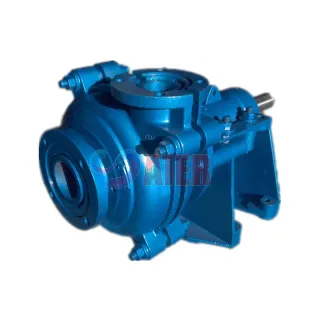
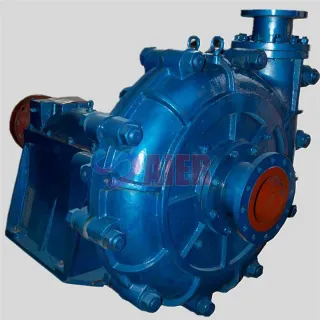
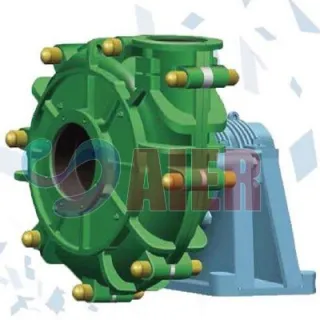
WG aukšto slėgio srutų siurblys
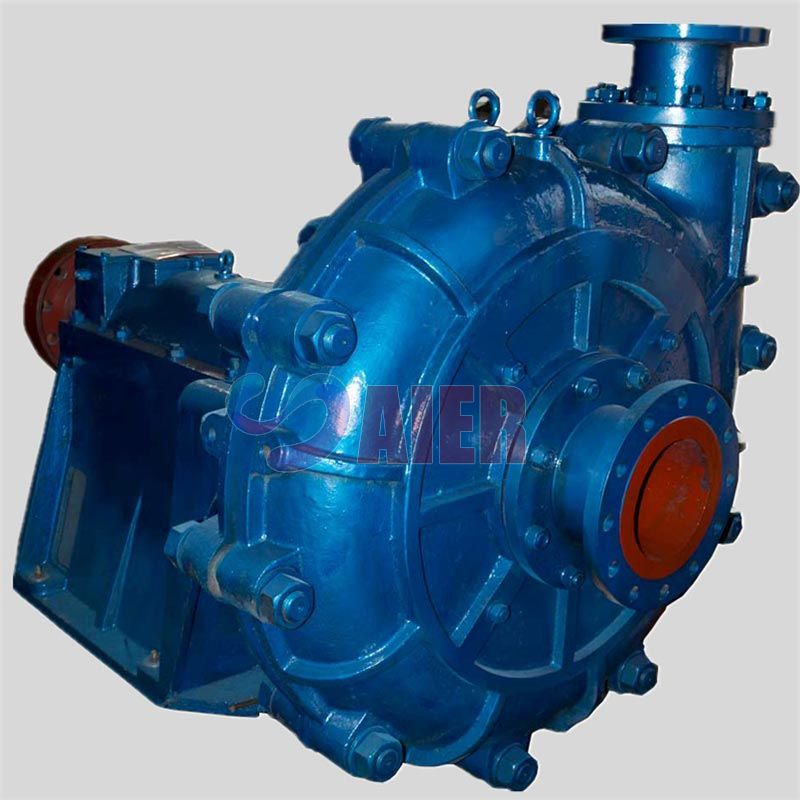
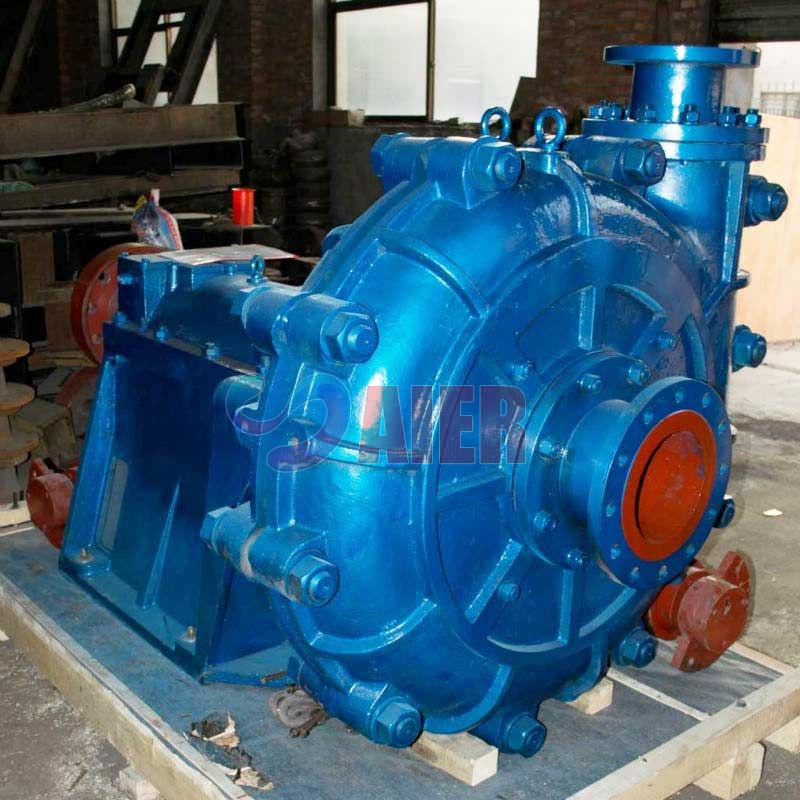
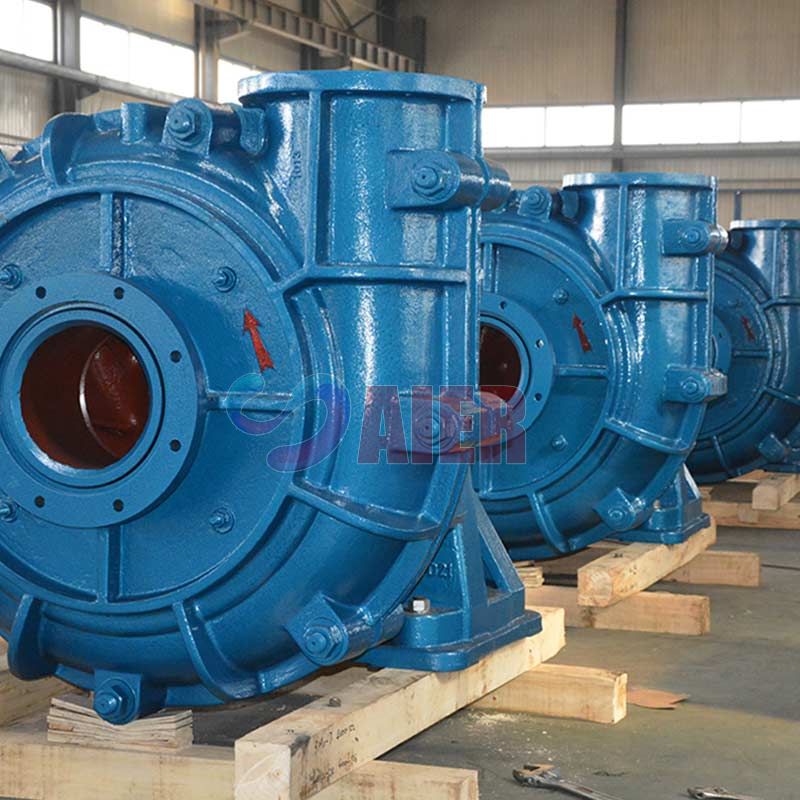
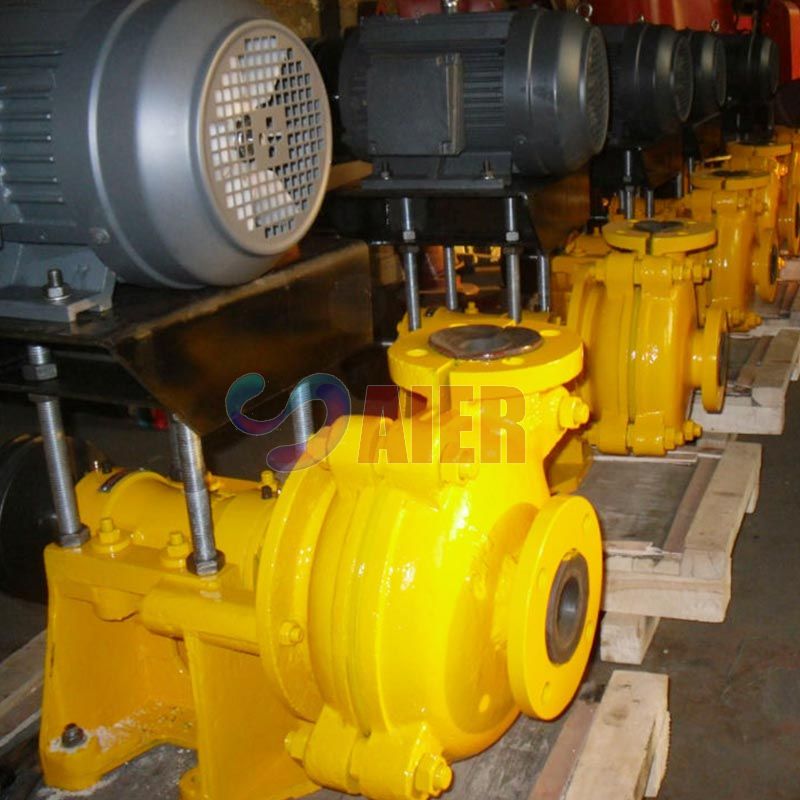
Siurblio įvadas
SPECIFIKACIJOS:
Dydis: 65-300mm
Našumas: 37-1919m3/val
Galva: 5-94m
Kietosios dalelės: 0-90 mm
Koncentracija: maks. 70 %
Maksimalus slėgis: Maks. 4,5 MPa
Medžiagos: hiperchromo lydinys ir kt.
AIER® WG High Efficiency Slurry Pump
In order to meet the requirements on the development of the electric power, metallurgy and coal industries, our company has designed and developed WG(P) Series up-to-date general slurry pump with large capacity, high head, multi-stages in series to remove ash & sludge and to deliver liquid-solids mixture, based on the experience of slurry pump design and manufacture for many years, and abstracting the research results of advanced technology from home and abroad.
funkcijos
CAD modernus dizainas, super hidraulinis našumas, didelis efektyvumas ir mažesnis dilimo greitis;
Platus praėjimas, neužsikimšantis ir geras NPSH veikimas;
Išspaudų sandariklis kartu su sandarinimo sandarikliu ir mechaniniu sandarikliu buvo pritaikytas siekiant užtikrinti, kad srutos nenutekėtų;
Patikimumo dizainas užtikrina ilgą MTBF (vidutinį laiką tarp įvykių);
Metrinis guolis su alyvos tepimu, pagrįstos tepimo ir aušinimo sistemos užtikrina, kad guolis veiktų žemoje temperatūroje;
Drėgnų dalių medžiagos gerai apsaugo nuo nusidėvėjimo ir antikorozijos;
Siurblys gali būti naudojamas jūros vandens pelenų šalinimui, kad būtų išvengta jūros vandens, druskos ir rūko korozijos bei elektrocheminės korozijos;
Siurblys gali būti naudojamas nuosekliai su kelių pakopų leistinu slėgiu.
Siurblys turi protingos konstrukcijos, didelio efektyvumo, patikimo veikimo ir lengvos priežiūros privalumus. Jis gali būti plačiai naudojamas tvarkyti mišinį, kuriame yra abrazyvinių ir korozinių kietųjų dalelių elektros energijos, metalurgijos, kasyklų, anglių, statybinių medžiagų ir chemijos pramonės padaliniuose, ypač pelenų ir dumblo šalinimui elektros elektrinėse.
Siurblio žymėjimas
100WG(P):
100: išleidimo angos skersmuo (mm)
WG: Aukšto slėgio srutų siurblys
P: Daugiapakopiai siurbliai (1-2 pakopų be ženklo)
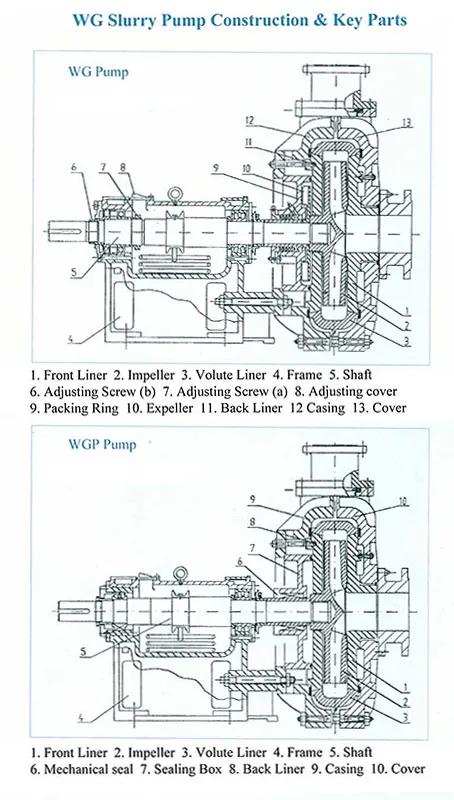
WG srutų siurblys yra horizontalus, vienos pakopos, vieno siurbimo, konsolinis, dvigubo korpuso, išcentrinis srutų siurblys. Siurblys sukasi pagal laikrodžio rodyklę žiūrint iš pavaros pusės.
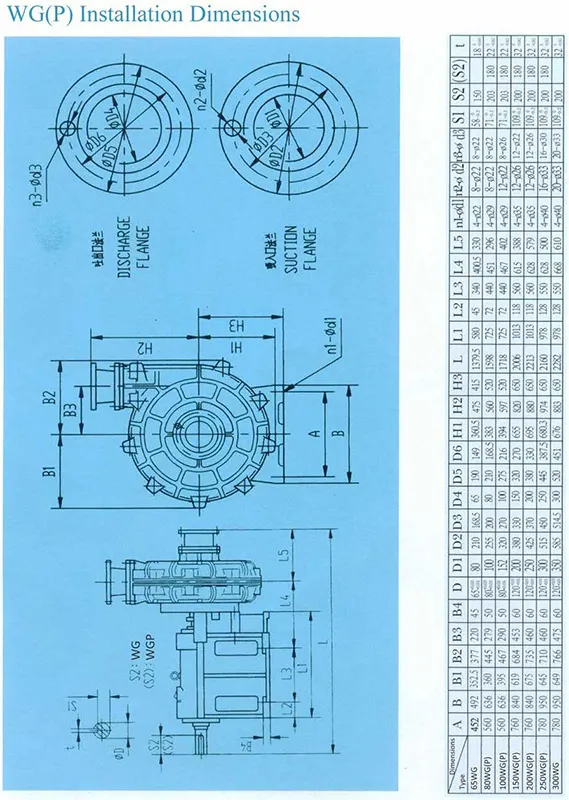
Drėgnos WG ir WGP siurblio dalys, kurių išleidimo angos skersmuo yra vienodos, gali būti keičiamos. Jų kontūriniai montavimo matmenys taip pat yra tokie patys. WG(P) srutų siurblio pavaros daliai pritaikytas horizontalus padalintas rėmas su alyvos tepalu ir dviem vandens aušinimo sistemomis viduje ir išorėje. Jei reikia, galima tiekti aušinimo vandenį. Paruoštą jungtį aušinimo vandeniui ir aušinimo vandens slėgį galite pamatyti 1 lentelėje.
Two kinds of shaft seal – expeller seal combined with packing and mechanical seal.
Mechaninis sandariklis, tiekiamas su aukšto slėgio sandarinimo vandeniu, rekomenduojamas, kai siurblys veikia nuosekliai, o išmetimo sandariklis kartu su sandarikliu naudojamas vienpakopiame siurblyje.
Vandens slėgis ir visų rūšių veleno sandariklių kiekis yra toks:
1) Sandarinimo vandens slėgis
Vienpakopis siurblys su išspaudimo sandarikliu kartu su sandarikliu, veleno sandariklio vandens slėgis yra 0,2–0,3 MPa.
Kelių pakopų nuosekliai veikiant su išspaudimo tarpikliu kartu su sandarikliu, sandarinimo vandens slėgis turi būti: Mažiausias n pakopos sandarinimo vandens slėgis = Hi + 0.7Hn Where: n ≥2.
Mechaninio sandariklio sandarinimo vandens slėgis kiekviename siurblio etape yra 0,1 Mpa didesnis nei slėgis siurblio išleidimo angoje
2) Sandarinimo vandens slėgis (žr. 1 lentelę)
1 lentelė: sandarinimo vandens parametrai
| Siurblio tipas | Rėmas | Sandarinimo vanduo (l/s) |
Vandens jungties sandarinimas | Aušinimo vandens jungtis Ant rėmo |
Aušinimo vandens slėgis |
| 65WG | 320 | 0.5 | 1/4" | 1/2", 3/8" | nuo 0,05 iki 0,2 MPa |
| 80 WG | 406 | 0.7 | 1/2" | 3/4", 1/2" | |
| 100WG | |||||
| 80WGP | 406A | ||||
| 100WGP | |||||
| 150WG | 565 | 1.2 | 1/2" | 3/4", 3/4" | |
| 200WG | |||||
| 150WGP | 565A | ||||
| 200WGP | |||||
| 250WG | 743 | 1" | |||
| 300WG | |||||
| 250WGP | 743A |
Statybos projektavimas
Siurblio dalies medžiaga
| Dalies pavadinimas | Medžiaga | Specifikacija | HRC | Taikymas | OEM kodas |
| Įdėklai ir sparnuotė | Metalas | AB27: 23–30 % chromo baltos geležies | ≥56 | Naudojamas didesnio susidėvėjimo sąlygoms, kai pH yra nuo 5 iki 12 | A05 |
| AB15: 14–18 % chromo baltojo geležies | ≥59 | Naudotas didesniam nusidėvėjimui | A07 | ||
| AB29: 27%-29% chromo baltos geležies | 43 | Naudojamas esant žemesniam pH sąlygoms, ypač FGD. Jis taip pat gali būti naudojamas mažai rūgštaus būsenos ir sieros pašalinimo įrenginiuose, kurių pH ne mažesnis kaip 4 | A49 | ||
| AB33: 33%-37% chromo baltos geležies | Jis gali transportuoti deguonies prisotintas srutas, kurių pH ne mažesnis kaip 1, pvz., fosforo tinką, azoto rūgštį, vitriolį, fosfatą ir kt. | A33 | |||
| Išspaudimo ir išspaudimo žiedas | Metalas | B27: 23–30 % chromo baltojo geležies | ≥56 | Naudojamas didesnio susidėvėjimo sąlygoms, kai pH yra nuo 5 iki 12 | A05 |
| Pilka geležis | G01 | ||||
| Įdaru Dėžė | Metalas | AB27: 23–30 % chromo baltos geležies | ≥56 | Naudojamas didesnio susidėvėjimo sąlygoms, kai pH yra nuo 5 iki 12 | A05 |
| Pilka geležis | G01 | ||||
| Rėmas / dangtelis, guolio korpusas ir pagrindas | Metalas | Pilka geležis | G01 | ||
| Kaliojo ketaus | D21 | ||||
| Velenas | Metalas | Anglinio plieno | E05 | ||
| Veleno įvorė, žibinto žiedas / varžtas, kaklo žiedas, riebokšlio varžtas | Nerūdijantis plienas | 4Cr13 | C21 | ||
| 304 SS | C22 | ||||
| 316 SS | C23 | ||||
| Jungčių žiedai ir sandarikliai | Guma | butilas | S21 | ||
| EPDM guma | S01 | ||||
| Nitrilas | S10 | ||||
| Hypalon | S31 | ||||
| Neoprenas | S44/S42 | ||||
| Vitonas | S50 |
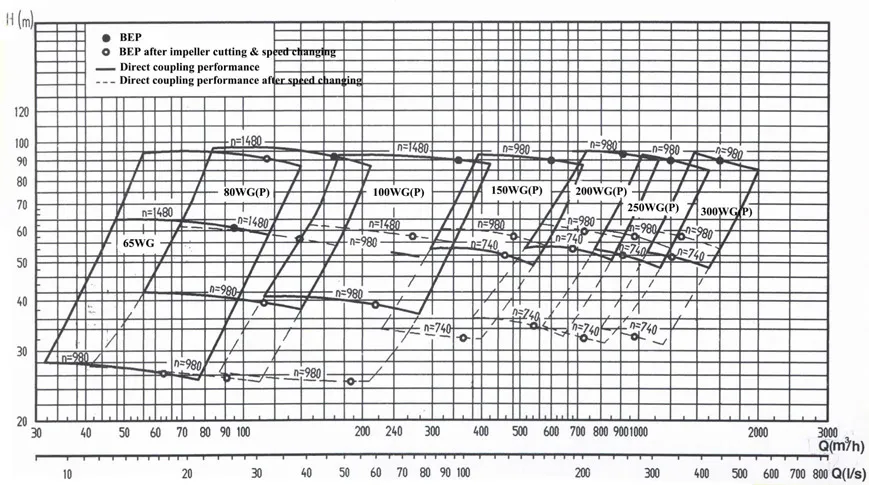
Našumo kreivė
Montavimo matmenys
The Role of High Head Slurry Pumps in Long-Distance Slurry Transport Systems
A high head slurry pump plays a pivotal role in transporting abrasive and dense slurries over long distances and significant vertical heights. Unlike standard industrial slurry pumps, high head pumps are specifically engineered to provide the increased pressure necessary for long pipeline systems, ensuring the efficient and consistent movement of solids-laden fluids.
In industries such as mining, mineral processing, coal preparation, and dredging, materials often need to be transported through extended pipelines, sometimes spanning hundreds of meters. The combination of high solids content, abrasive particles, and long transport distances makes conventional pumps unsuitable, as they may fail under high head conditions or suffer from excessive wear. A high head slurry pump addresses these challenges by delivering reliable performance while maintaining operational efficiency.
The design of a high head slurry pump emphasizes durability and resistance to wear. Casings and impellers are often made of high-chrome alloys or wear-resistant metals, allowing the pump to handle abrasive slurries with minimal erosion. Many slurry pump manufacturers also offer customizable options, such as modular impellers and liners, enabling easy maintenance and replacement, thereby reducing downtime and maintenance costs.
Additionally, high head slurry pumps are engineered for optimal hydraulic performance. Their impeller and volute designs minimize energy loss, allowing slurries to be transported at higher pressures without overloading the motor or increasing operational costs. This energy-efficient design is particularly important in industrial settings, where large volumes of slurry must be moved continuously over extended distances.
Applications of high head slurry pumps include tailings disposal, long-distance slurry transport from mines to processing plants, and chemical slurry movement in metallurgical operations. Their ability to sustain high pressures and manage abrasive fluids reliably makes them a critical component in industrial processes.
In conclusion, a high head slurry pump is essential for long-distance slurry transport systems, offering high pressure, durability, and efficiency. Selecting a reliable slurry pump manufacturer ensures that your plant receives a customized, high-performance solution tailored to demanding industrial applications.
How High Head Slurry Pumps Improve Efficiency in Mining and Processing Plants
Mining and mineral processing plants require robust equipment capable of handling abrasive slurries with high solids content. A high head slurry pump is integral in these facilities, enhancing efficiency, reducing energy consumption, and minimizing maintenance needs. By delivering high pressure and flow over long distances, these pumps streamline material handling and improve overall plant productivity.
In mining operations, tailings and ore slurries often need to be transported from extraction sites to processing plants or storage areas. A high head slurry pump is specifically designed to handle this workload, maintaining consistent flow rates even with challenging slurry compositions. This ensures that production lines run smoothly without bottlenecks or downtime caused by pump failure.
The efficiency of a high head slurry pump also translates to energy savings. Advanced impeller designs and optimized hydraulic profiles reduce friction losses and pump energy requirements. Many industrial slurry pumps from reputable slurry pump manufacturers are designed with high efficiency in mind, allowing plants to lower operational costs while maintaining the required throughput.
Maintenance is another area where high head slurry pumps provide advantages. These pumps are constructed with wear-resistant materials such as high-chrome alloys or alloy steels, minimizing erosion from abrasive particles. Replaceable liners and impellers allow maintenance teams to perform targeted repairs without dismantling the entire pump system, reducing downtime and labor costs.
Furthermore, these pumps are available in various configurations, including horizontal and vertical designs, enabling flexible installation in confined or challenging spaces. The modular construction also supports scalability, allowing mining and processing plants to adjust pump capacity as operational needs evolve.
In summary, using a high head slurry pump in mining and processing plants improves slurry transport efficiency, reduces energy consumption, and minimizes maintenance costs. Partnering with a reliable slurry pump manufacturer ensures access to high-quality, durable pumps capable of withstanding abrasive industrial conditions while delivering long-term performance.
Material Selection for High Head Slurry Pumps: Metal vs Alloy
Selecting the appropriate material for a high head slurry pump is crucial to maximize performance, wear resistance, and operational lifespan. Industrial applications often involve abrasive and corrosive slurries, which can quickly erode or damage pumps made from unsuitable materials. Choosing between metal and alloy construction depends on the specific process requirements and the slurry’s characteristics.
Traditional metal slurry pumps are typically made of ductile iron or stainless steel, offering robust structural strength and corrosion resistance. These materials are suitable for moderate abrasiveness and provide reliable long-term service. However, in highly abrasive conditions, such as those found in mining or mineral processing, standard metals may wear quickly, leading to reduced efficiency and increased maintenance costs.
Alloy construction, especially high-chrome or nickel-chrome alloys, offers superior wear resistance and hardness, making them ideal for heavy-duty industrial slurry transport. A high head slurry pump made from these materials can handle slurries with high solids concentrations and large particle sizes without rapid erosion. The enhanced durability ensures continuous operation with minimal downtime, which is essential for high-capacity industrial processes.
Many slurry pump manufacturers offer modular designs that allow clients to choose between metal or alloy liners and impellers based on operational needs. This flexibility enables plants to optimize pump longevity and reduce maintenance frequency. Additionally, alloy materials can improve hydraulic performance by maintaining smooth surfaces within the pump, reducing energy losses and improving overall efficiency.
The selection of materials also impacts cost-effectiveness. While alloy pumps may have higher initial investment costs compared to standard metals, their extended service life and reduced maintenance requirements often result in lower total operational costs over time. Industrial facilities that prioritize reliability and efficiency benefit significantly from investing in high-quality alloy high head slurry pumps.
In conclusion, material selection for a high head slurry pump plays a decisive role in durability, efficiency, and cost-effectiveness. Whether using metal or alloy construction, choosing a reliable slurry pump manufacturer ensures that the pump is tailored to handle demanding industrial slurries while providing long-term operational performance.
Produktų kategorijos
-
WA Didelio našumo srutų siurblys
-
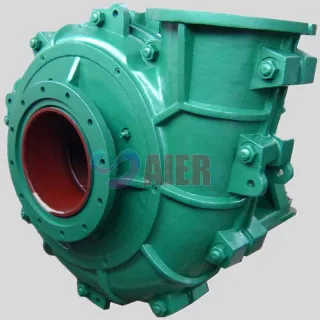
WG aukšto slėgio srutų siurblys
-
WL lengvas srutų siurblys
-
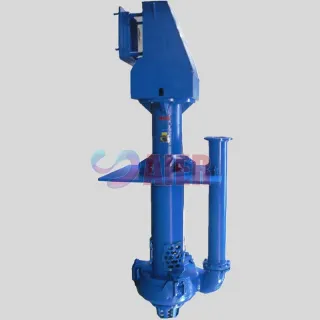
WY karterio siurblys
-
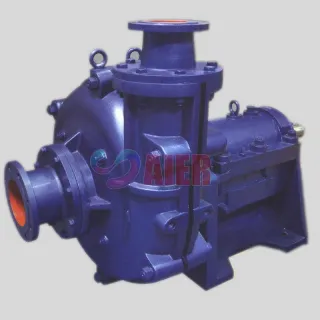
WZ didelio efektyvumo srutų siurblys
-
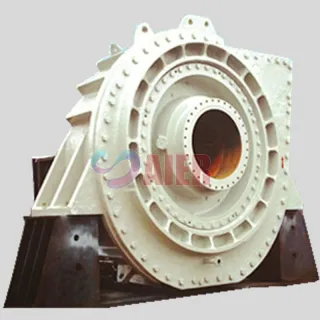
WN žemsiurbės siurblys
-
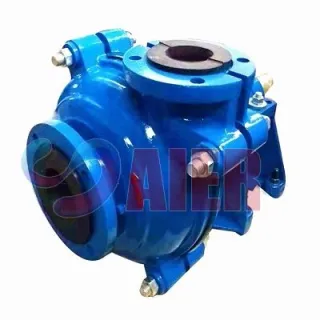
WAJ guminis srutų siurblys
-
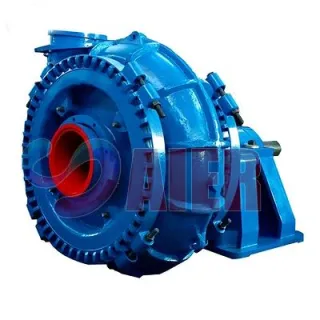
WS, WSG žvyro smėlio siurblys
-
WS, WSH tirpalo siurblys
-
WY karterio siurblys
-
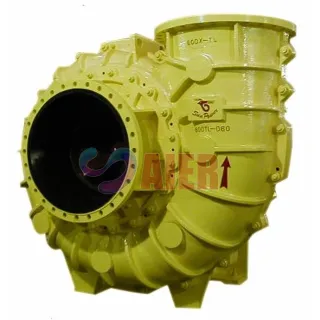
TL, TLR FGD siurblys
-
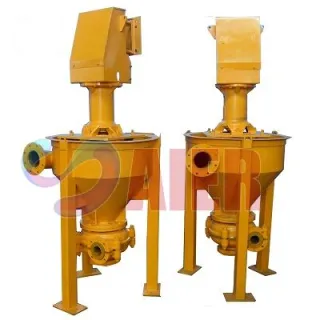
WP vertikalus putų siurblys
-
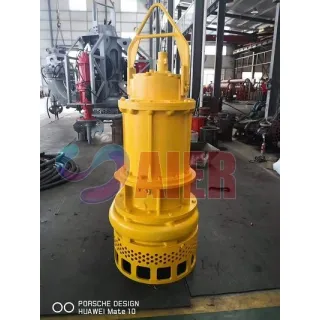
ZJQ panardinamieji srutų siurbliai
-
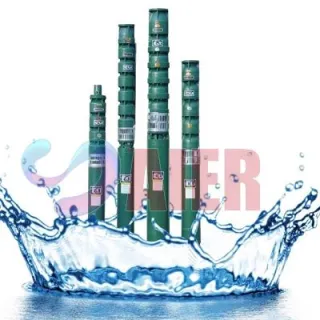
QJ povandeninis siurblys
-
ACT (ZCT) keraminiai srutų siurbliai
-
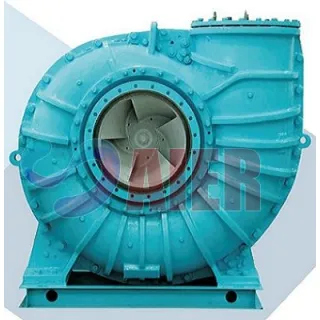
BCT keraminiai srutų siurbliai