
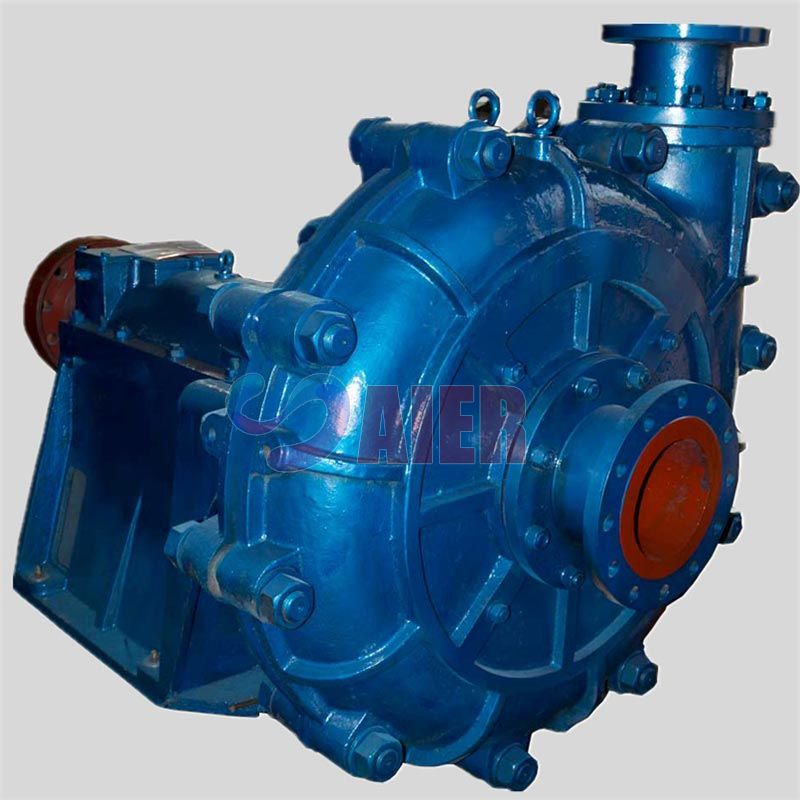
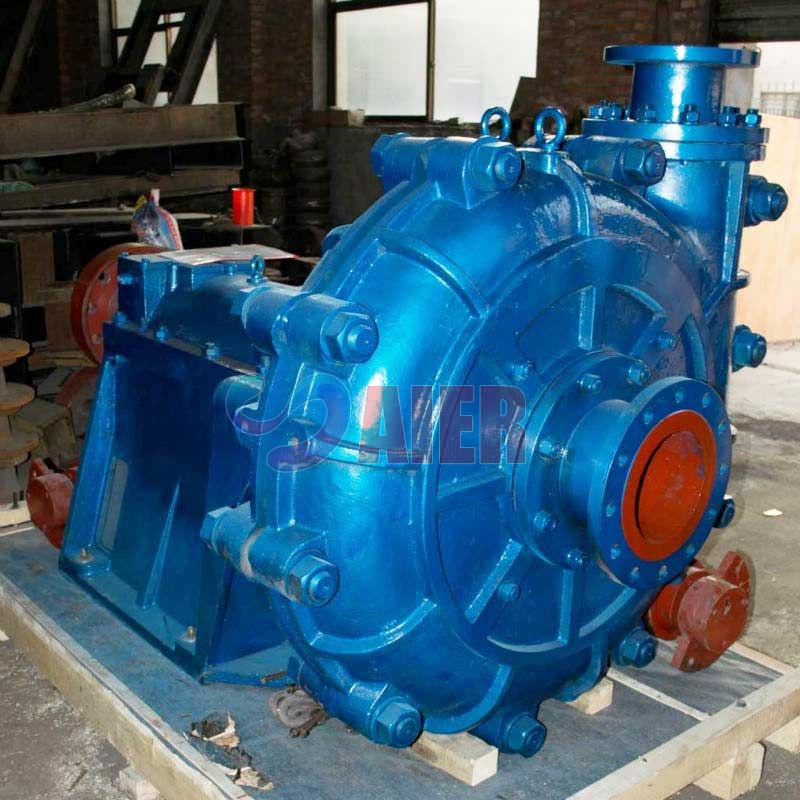
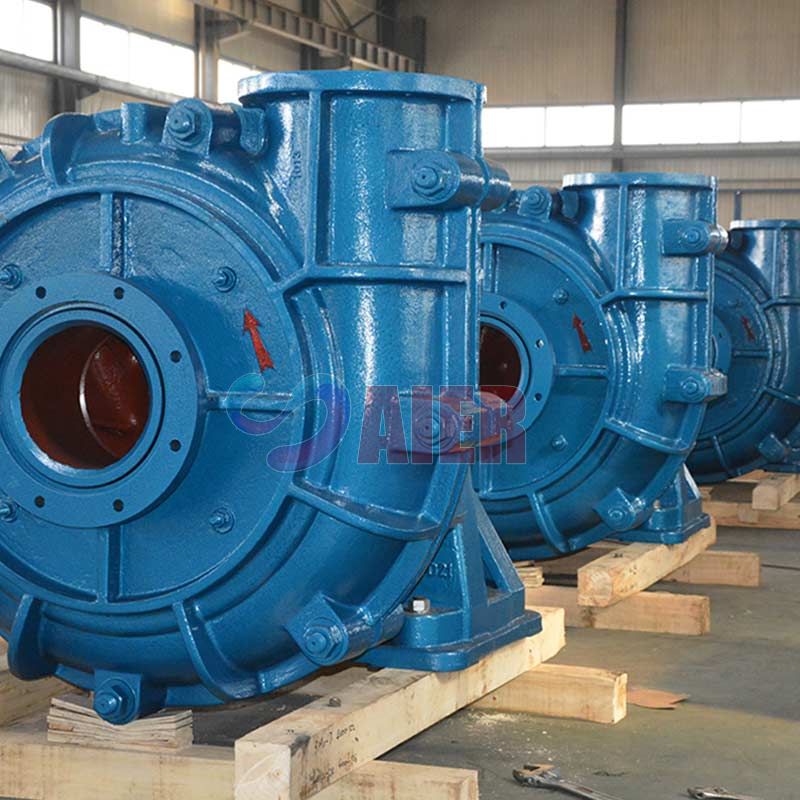
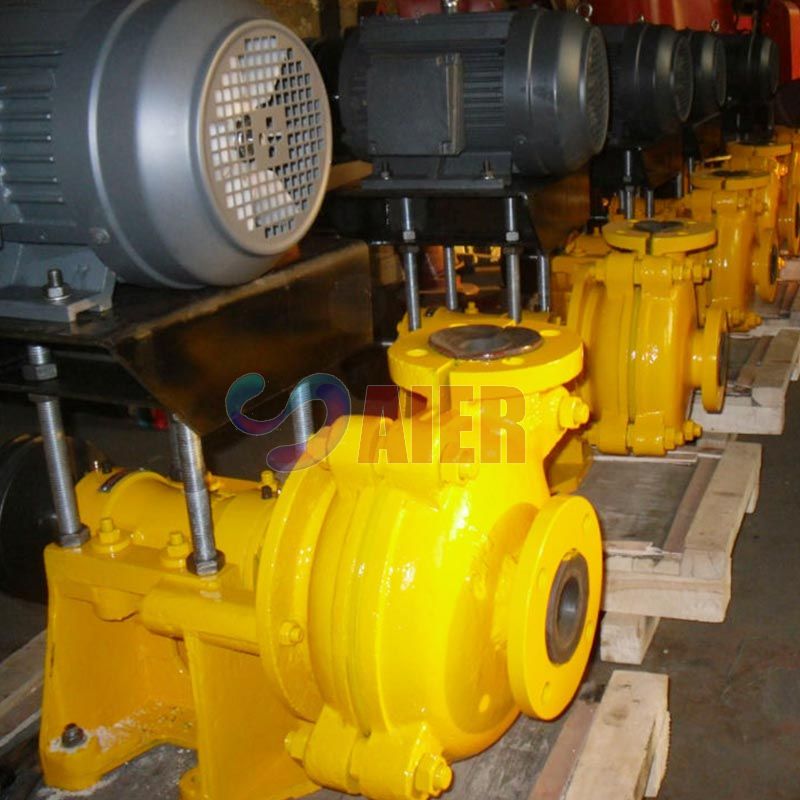
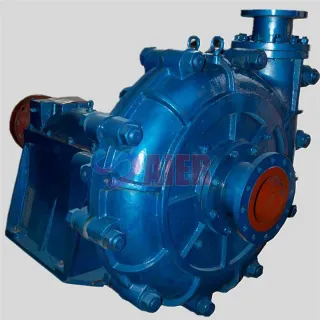
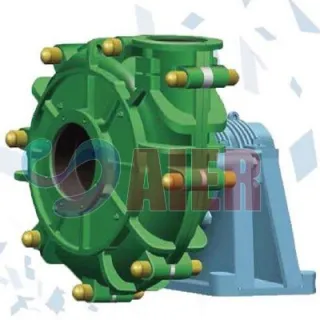
Bomba de polpa de cabeça alta WG
Introdução à bomba
ESPECIFICAÇÕES:
Tamanho: 65-300mm
Capacidade: 37-1919m3/h
Cabeça: 5-94m
Entrega de sólidos: 0-90mm
Concentração: Máx.70%
Pressão máxima: Máx.4,5mpa
Materiais: liga hipercromada etc.
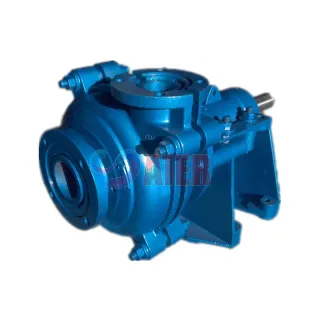
AIER® WG High Efficiency Slurry Pump
In order to meet the requirements on the development of the electric power, metallurgy and coal industries, our company has designed and developed WG(P) Series up-to-date general slurry pump with large capacity, high head, multi-stages in series to remove ash & sludge and to deliver liquid-solids mixture, based on the experience of slurry pump design and manufacture for many years, and abstracting the research results of advanced technology from home and abroad.
Características
Design moderno CAD, desempenho superhidráulico, alta eficiência e menor taxa de abrasão;
Passagem ampla, não entupimento e bom desempenho de NPSH;
A vedação do expulsor combinada com a vedação da embalagem e a vedação mecânica foram adotadas para garantir que a lama não vaze;
O design de confiabilidade garante longo MTBF (tempo médio entre eventos);
O rolamento métrico com lubrificação a óleo e sistemas razoáveis de lubrificação e resfriamento garantem que o rolamento seja operado sob baixa temperatura;
Os materiais das peças úmidas apresentam bom desempenho antidesgaste e anticorrosivo;
A bomba pode ser usada para remoção de cinzas de água do mar para evitar a corrosão da água do mar, sal e névoa e corrosão eletroquímica;
A bomba pode ser operada em série com vários estágios dentro da pressão permitida.
A bomba tem as vantagens de construção razoável, alta eficiência, operação confiável e fácil manutenção. Pode ser amplamente utilizado para manusear a mistura contida de sólidos abrasivos e corrosivos em departamentos de energia elétrica, metalurgia, minas, carvão, material de construção e indústria química, especialmente para remoção de cinzas e lodo em usinas de energia elétrica.
Notação de bomba
100WG(P):
100: Diâmetro de saída (mm)
WG: Bomba de polpa de cabeça alta
P: Bombas multiestágio (1-2 estágios sem marca)
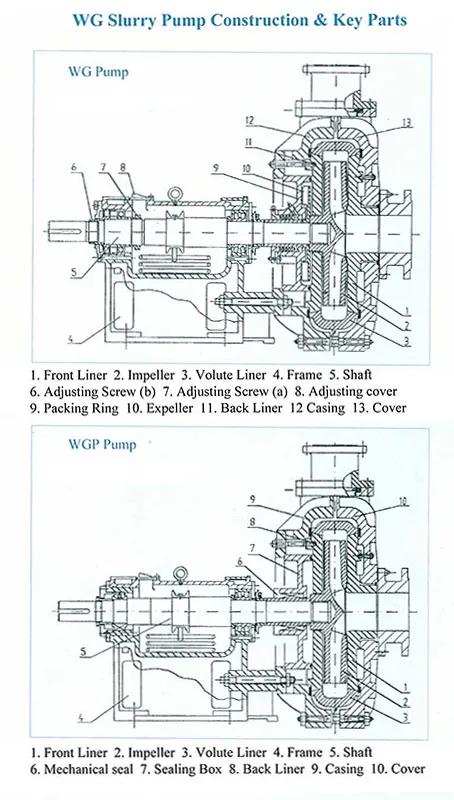
A bomba de polpa WG é uma bomba de polpa centrífuga horizontal, de estágio único, de sucção única, em balanço, de corpo duplo. A bomba gira no sentido horário vista da extremidade de acionamento.
As partes úmidas das bombas WG e WGP com o mesmo diâmetro de saída podem ser intercambiáveis. Suas dimensões gerais de instalação também são as mesmas. Para a parte de acionamento da bomba de polpa WG(P), foi adotada a estrutura dividida horizontal com lubrificação a óleo e dois conjuntos de sistemas de resfriamento de água interno e externo. Se necessário, pode ser fornecida água de resfriamento. A junta preparada para resfriamento da água e a pressão da água de resfriamento podem ser visualizadas na tabela 1.
Two kinds of shaft seal – expeller seal combined with packing and mechanical seal.
O selo mecânico fornecido com água de vedação de alta pressão é recomendado quando a bomba é operada em série, e o selo do expulsor combinado com a gaxeta é usado em bombas monoestágio.
A pressão e a quantidade da água de todos os tipos de vedação do eixo são as seguintes:
1) Pressão da água de vedação
Para bomba de estágio único com vedação do expulsor combinada com gaxeta, a pressão da água da vedação do eixo é de 0,2-0,3 Mpa.
Para operação em série de vários estágios com o selo do expulsor combinado com a gaxeta, a pressão da água de vedação deve ser: A pressão mais baixa da água de vedação do estágio n = Hi + 0.7Hn Where: n ≥2.
Para selo mecânico, a pressão da água de vedação de cada estágio da bomba é 0,1Mpa superior à pressão na saída da bomba
2) Pressão da água de vedação (ver tabela 1)
Tabela 1: parâmetros da água de vedação
| Tipo de bomba | Quadro | Água de vedação (l/s) |
Vedação de junta de água | Junta de água de resfriamento No quadro |
Pressão da água de resfriamento |
| 65WG | 320 | 0.5 | 1/4" | 1/2", 3/8" | 0,05 a 0,2 MPa |
| 80 GT | 406 | 0.7 | 1/2" | 3/4", 1/2" | |
| 100WG | |||||
| 80WGP | 406A | ||||
| 100 WGP | |||||
| 150WG | 565 | 1.2 | 1/2" | 3/4", 3/4" | |
| 200WG | |||||
| 150 WGP | 565A | ||||
| 200 WGP | |||||
| 250WG | 743 | 1" | |||
| 300WG | |||||
| 250 WGP | 743A |
Projeto de Construção
Material da peça da bomba
| Nome da peça | Material | Especificação | CDH | Aplicativo | Código OEM |
| Revestimentos e impulsor | Metal | AB27: 23%-30% de ferro branco cromado | ≥56 | Usado para condições de maior desgaste com pH entre 5 e 12 | A05 |
| AB15: 14%-18% de ferro branco cromado | ≥59 | Usado para condições de maior desgaste | A07 | ||
| AB29: 27%-29% de ferro branco cromado | 43 | Usado para condições de pH mais baixo, especialmente para FGD. Também pode ser usado para condições de baixa acidez e instalações de dessulfuração com pH não inferior a 4 | A49 | ||
| AB33: 33%-37% de ferro branco cromado | Pode transportar lama oxigenada com pH não inferior a 1, como gesso fosfórico, ácido nítrico, vitríolo, fosfato, etc. | A33 | |||
| Expulsor e anel expelidor | Metal | B27: 23%-30% de ferro branco cromado | ≥56 | Usado para condições de maior desgaste com pH entre 5 e 12 | A05 |
| Ferro cinzento | G01 | ||||
| Caixa de recheio | Metal | AB27: 23%-30% de ferro branco cromado | ≥56 | Usado para condições de maior desgaste com pH entre 5 e 12 | A05 |
| Ferro cinzento | G01 | ||||
| Estrutura/placa de cobertura, caixa de rolamento e base | Metal | Ferro cinzento | G01 | ||
| Ferro dúctil | D21 | ||||
| Haste | Metal | Aço carbono | E05 | ||
| Luva do eixo, anel lanterna/restritor, anel de pescoço, parafuso da sobreposta | Aço inoxidável | 4Cr13 | Capítulo 21 | ||
| 304 SS | C22 | ||||
| 316SS | Capítulo 23 | ||||
| Anéis e vedações de junta | Borracha | Butilo | S21 | ||
| Borracha EPDM | S01 | ||||
| Nitrila | S10 | ||||
| Hipalon | T31 | ||||
| Neoprene | S44/S42 | ||||
| Viton | S50 |
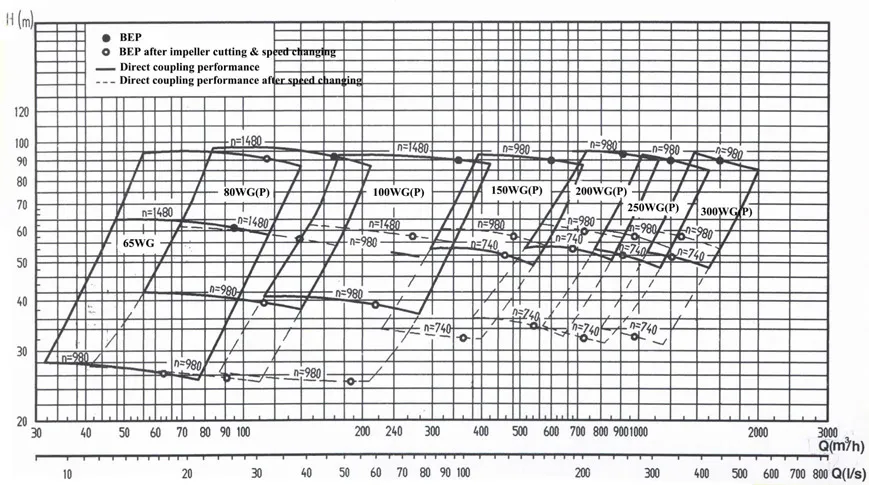
Curva de desempenho
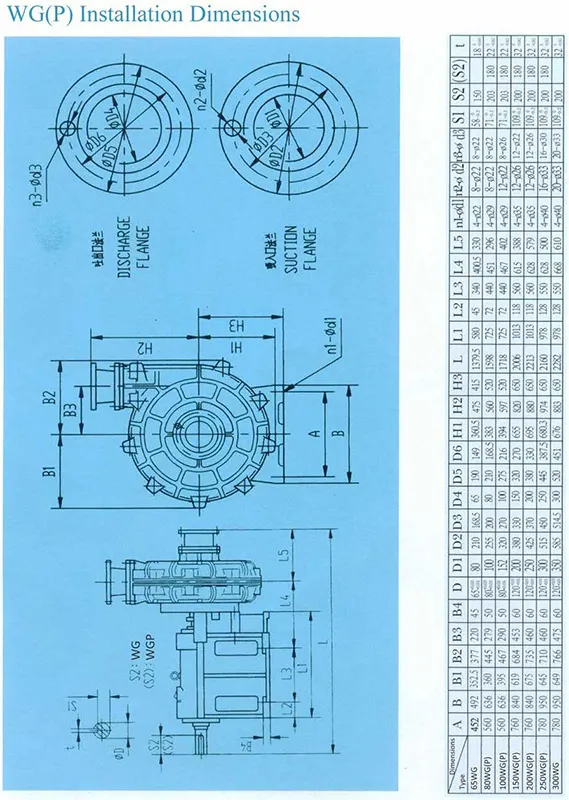
Dimensões de instalação
The Role of High Head Slurry Pumps in Long-Distance Slurry Transport Systems
A high head slurry pump plays a pivotal role in transporting abrasive and dense slurries over long distances and significant vertical heights. Unlike standard industrial slurry pumps, high head pumps are specifically engineered to provide the increased pressure necessary for long pipeline systems, ensuring the efficient and consistent movement of solids-laden fluids.
In industries such as mining, mineral processing, coal preparation, and dredging, materials often need to be transported through extended pipelines, sometimes spanning hundreds of meters. The combination of high solids content, abrasive particles, and long transport distances makes conventional pumps unsuitable, as they may fail under high head conditions or suffer from excessive wear. A high head slurry pump addresses these challenges by delivering reliable performance while maintaining operational efficiency.
The design of a high head slurry pump emphasizes durability and resistance to wear. Casings and impellers are often made of high-chrome alloys or wear-resistant metals, allowing the pump to handle abrasive slurries with minimal erosion. Many slurry pump manufacturers also offer customizable options, such as modular impellers and liners, enabling easy maintenance and replacement, thereby reducing downtime and maintenance costs.
Additionally, high head slurry pumps are engineered for optimal hydraulic performance. Their impeller and volute designs minimize energy loss, allowing slurries to be transported at higher pressures without overloading the motor or increasing operational costs. This energy-efficient design is particularly important in industrial settings, where large volumes of slurry must be moved continuously over extended distances.
Applications of high head slurry pumps include tailings disposal, long-distance slurry transport from mines to processing plants, and chemical slurry movement in metallurgical operations. Their ability to sustain high pressures and manage abrasive fluids reliably makes them a critical component in industrial processes.
In conclusion, a high head slurry pump is essential for long-distance slurry transport systems, offering high pressure, durability, and efficiency. Selecting a reliable slurry pump manufacturer ensures that your plant receives a customized, high-performance solution tailored to demanding industrial applications.
How High Head Slurry Pumps Improve Efficiency in Mining and Processing Plants
Mining and mineral processing plants require robust equipment capable of handling abrasive slurries with high solids content. A high head slurry pump is integral in these facilities, enhancing efficiency, reducing energy consumption, and minimizing maintenance needs. By delivering high pressure and flow over long distances, these pumps streamline material handling and improve overall plant productivity.
In mining operations, tailings and ore slurries often need to be transported from extraction sites to processing plants or storage areas. A high head slurry pump is specifically designed to handle this workload, maintaining consistent flow rates even with challenging slurry compositions. This ensures that production lines run smoothly without bottlenecks or downtime caused by pump failure.
The efficiency of a high head slurry pump also translates to energy savings. Advanced impeller designs and optimized hydraulic profiles reduce friction losses and pump energy requirements. Many industrial slurry pumps from reputable slurry pump manufacturers are designed with high efficiency in mind, allowing plants to lower operational costs while maintaining the required throughput.
Maintenance is another area where high head slurry pumps provide advantages. These pumps are constructed with wear-resistant materials such as high-chrome alloys or alloy steels, minimizing erosion from abrasive particles. Replaceable liners and impellers allow maintenance teams to perform targeted repairs without dismantling the entire pump system, reducing downtime and labor costs.
Furthermore, these pumps are available in various configurations, including horizontal and vertical designs, enabling flexible installation in confined or challenging spaces. The modular construction also supports scalability, allowing mining and processing plants to adjust pump capacity as operational needs evolve.
In summary, using a high head slurry pump in mining and processing plants improves slurry transport efficiency, reduces energy consumption, and minimizes maintenance costs. Partnering with a reliable slurry pump manufacturer ensures access to high-quality, durable pumps capable of withstanding abrasive industrial conditions while delivering long-term performance.
Material Selection for High Head Slurry Pumps: Metal vs Alloy
Selecting the appropriate material for a high head slurry pump is crucial to maximize performance, wear resistance, and operational lifespan. Industrial applications often involve abrasive and corrosive slurries, which can quickly erode or damage pumps made from unsuitable materials. Choosing between metal and alloy construction depends on the specific process requirements and the slurry’s characteristics.
Traditional metal slurry pumps are typically made of ductile iron or stainless steel, offering robust structural strength and corrosion resistance. These materials are suitable for moderate abrasiveness and provide reliable long-term service. However, in highly abrasive conditions, such as those found in mining or mineral processing, standard metals may wear quickly, leading to reduced efficiency and increased maintenance costs.
Alloy construction, especially high-chrome or nickel-chrome alloys, offers superior wear resistance and hardness, making them ideal for heavy-duty industrial slurry transport. A high head slurry pump made from these materials can handle slurries with high solids concentrations and large particle sizes without rapid erosion. The enhanced durability ensures continuous operation with minimal downtime, which is essential for high-capacity industrial processes.
Many slurry pump manufacturers offer modular designs that allow clients to choose between metal or alloy liners and impellers based on operational needs. This flexibility enables plants to optimize pump longevity and reduce maintenance frequency. Additionally, alloy materials can improve hydraulic performance by maintaining smooth surfaces within the pump, reducing energy losses and improving overall efficiency.
The selection of materials also impacts cost-effectiveness. While alloy pumps may have higher initial investment costs compared to standard metals, their extended service life and reduced maintenance requirements often result in lower total operational costs over time. Industrial facilities that prioritize reliability and efficiency benefit significantly from investing in high-quality alloy high head slurry pumps.
In conclusion, material selection for a high head slurry pump plays a decisive role in durability, efficiency, and cost-effectiveness. Whether using metal or alloy construction, choosing a reliable slurry pump manufacturer ensures that the pump is tailored to handle demanding industrial slurries while providing long-term operational performance.
Categorias de produtos
-
Bomba de polpa para serviço pesado WA
-
Bomba de polpa de cabeça alta WG
-
Bomba de polpa para serviços leves WL
-
Bomba de depósito WY
-
Bomba de polpa de alta eficiência WZ
-
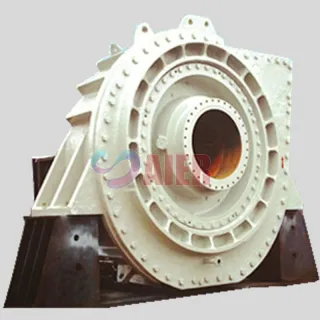
Bomba de dragagem WN
-
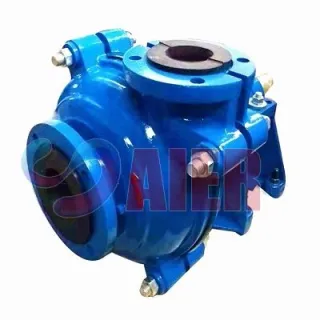
Bomba de polpa de borracha WAJ
-
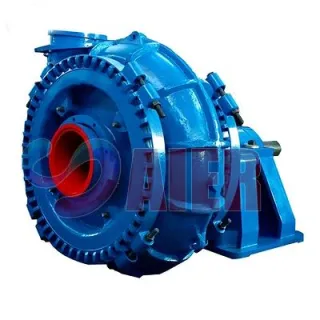
WS, bomba de areia de cascalho WSG
-
WS, bomba de solução WSH
-
Bomba de depósito WY
-
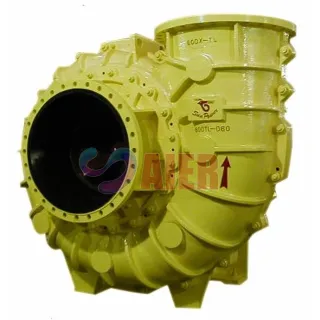
Bomba TL, TLR FGD
-
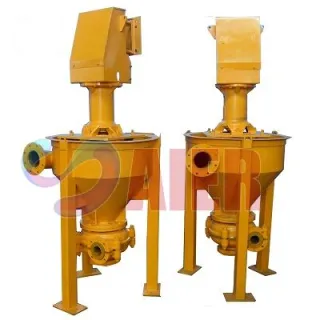
Bomba de espuma vertical WP
-
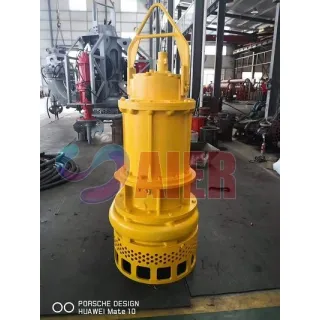
Bombas de polpa submersíveis ZJQ
-
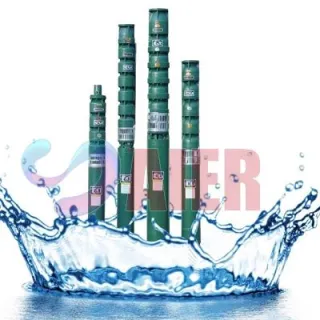
BOMBA Submersível QJ
-
Bombas de polpa cerâmica ACT (ZCT)
-
Bombas de polpa cerâmica BCT