
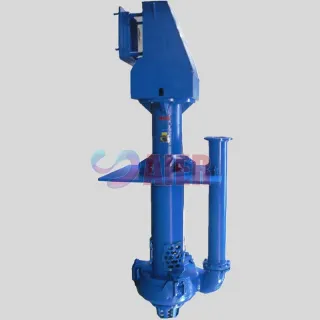
WY sūknis





Produkta apraksts
SPECIFIKĀCIJAS:
Izmērs (izlāde): no 40 mm līdz 300 mm
Jauda: 7,28-1300 m3/h
Galva: 3m-45 m
Cietvielu nodošana: 0-79 mm
Koncentrācija: 0–70%
Materiāli: augsts hroma sakausējums, gumija,
Poliuretāns, keramika, nerūsējošais tērauds utt.
AIER® WY Sump Pump
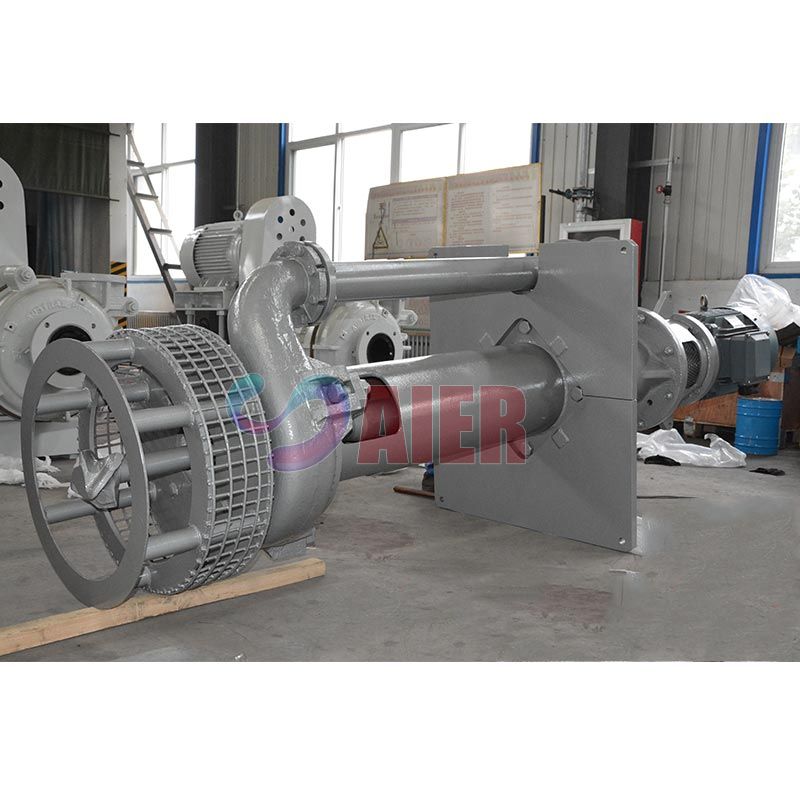
WY un WYJ kartera sūknis ir vertikāls centrbēdzes vircas sūknis, kas iegremdēts abrazīvu, rupju daļiņu un augsta blīvuma vircas pārvietošanai. Strādājot, tam nav nepieciešams blīvējuma ūdens vai jebkāda veida blīvējums. Tas var darboties arī tad, ja sūkšanas apjoms nav pietiekams.
Tipiski pielietojumi
Kartera drenāža vai mazgāšana
Grīdu drenāža
Dzirnavu karteris
Oglekļa pārnešana
Uzraudzība
Magnētīta sajaukšana
Iespējas
WY tipa sūkņa korpuss ir izgatavots no nodilumizturīga metāla, lāpstiņriteņa materiāls var būt nodilumizturīgs metāls vai gumija.
Visas WYJ iegremdētās daļas ir pārklātas ar gumiju, lai pārnestu kodīgu vircu.
Sūkņa apzīmējums
150WY-S:
150: Izplūdes diametrs: mm
WY: Sūkņa tips: Kartera sūknis ar augstu hroma sakausējumu
S: Rāmja plāksnes tips
150WYJ-S:
150: Izplūdes diametrs: mm
WYJ: Sūkņa tips: Sūknis ar gumijas pārklājumu
S: Rāmja plāksnes tips
Būvniecības projektēšana
WY augsta hroma sakausējuma oderējums
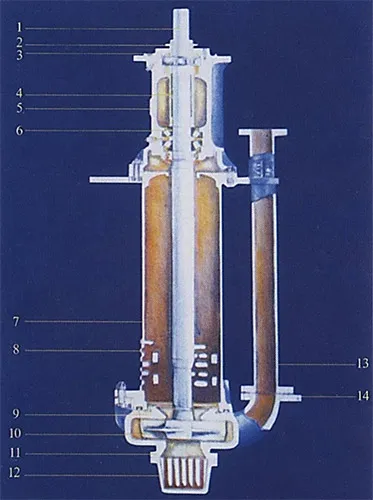 |
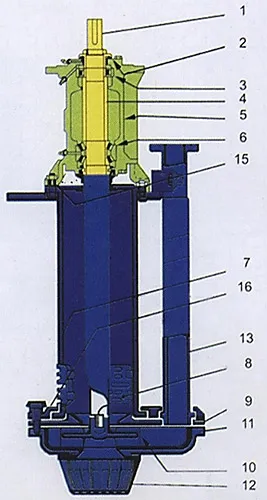
1. Vārpsta 2. Labirints 3. Gultnis 4. Gultņa starplika 5. Gultņa korpuss 6. Gultnis 7. Kolonna 8. Sietiņš 9. Back Liner 10. Darbrats 11. Sūkņa korpuss 12. Apakšējais sietiņš 13. Izplūdes caurule 14. Sadalītās izlādes atloks |
|
1. Vārpsta 2. Labirints 3. Gultnis 4. Gultņa starplika 5. Gultņa korpuss 6. Gultnis 7. Kolonna 8. Sietiņš 9. Back Liner 10. Darbrats 11. Sūkņa korpuss 12. Apakšējais sietiņš 13. Izplūdes caurule 15. Kolonnas skrūve un uzgrieznis 16. Kolonnas skrūve |
 |
Sūkņa daļas materiāls
| Daļas nosaukums | Materiāls | Specifikācija | HRC | Pieteikums | OEM kods |
| Korpuss, aizmugures starplika un lāpstiņritenis | Cietais metāls | AB8: KmTBCr8 | ≥55 | Izmanto dubļu sūknim | A01 |
| AM: KmTBMnMo | 38-42 | Lietots vieglam nodilumam ar smalkiem graudiem | A11 | ||
| AB27: 23%-30% hroma balta dzelzs | ≥56 | Izmanto augstāka nodiluma apstākļos ar pH no 5 līdz 12 | A05 | ||
| AB15: 14%-18% hroma balta dzelzs | ≥59 | Lietots augstākam nodiluma stāvoklim | A07 | ||
| AB29: 27%-29% hroma balta dzelzs | 43 | Izmanto zemākam pH stāvoklim, īpaši FGD. To var izmantot arī zemskābā stāvoklī un desulfurizācijas iekārtām ar pH ne mazāku par 4 | A49 | ||
| AB33: 33%-37% hroma balta dzelzs | Tas var transportēt ar skābekli bagātinātu vircu, kuras pH nav mazāks par 1, piemēram, fosfora apmetumu, slāpekļskābi, vitriolu, fosfātu utt. | A33 | |||
| Gumija | R08 | ||||
| R26 | |||||
| R33 | |||||
| R55 | |||||
| Vārpsta | Metāls | Oglekļa tērauds | E05 | ||
| Savienojumu gredzeni un blīves | Gumija | Butils | S21 | ||
| EPDM gumija | S01 | ||||
| Nitrils | S10 | ||||
| Hypalon | S31 | ||||
| Neoprēns | S44/S42 | ||||
| Vitons | S50 |
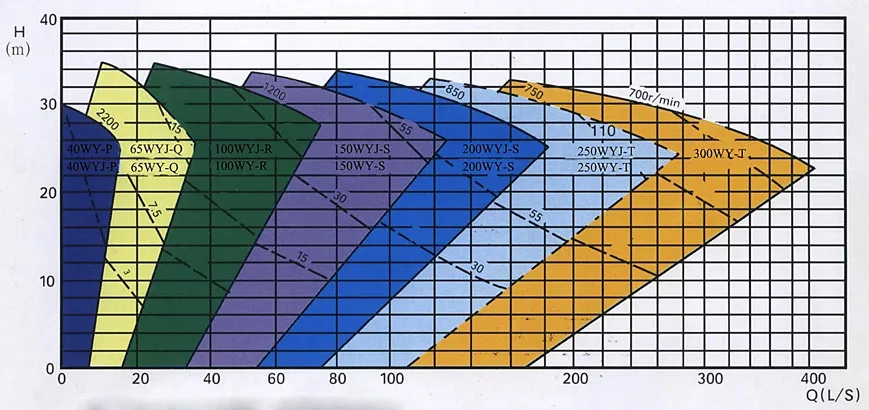
Skaidra ūdens sniegums
1
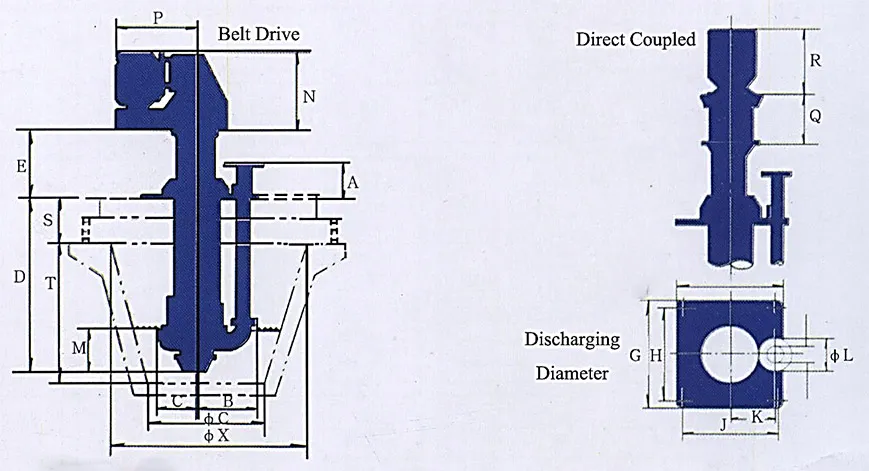
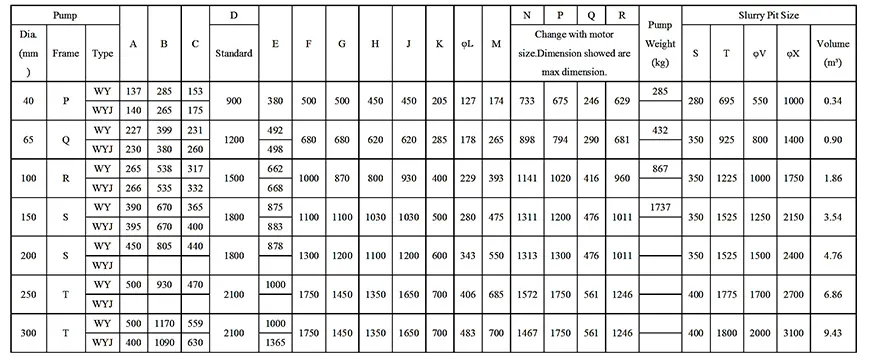
Uzstādīšanas izmēri
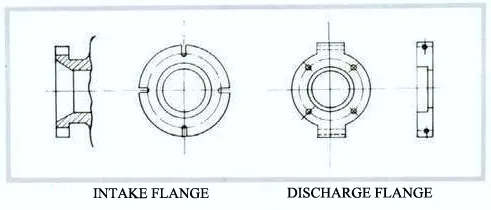
| Tips | Ieplūdes atloks | Izplūdes atloks | ||||||
| OD | ID | C/C Priekš Caurumi |
Caurums | OD | ID | C/C Priekš Caurumi |
Caurums | |
| 40WY-P | φ170 | φ81 | φ140 | 4-φ14 | φ127 | φ40 | φ98 | 4-φ16 |
| 40WYJ-P | ||||||||
| 65WY-Q | φ240 | φ104 | φ215 | 4-φ14 | φ178 | φ65 | φ140 | 4-φ19 |
| 65WYJ-Q | ||||||||
| 100WY-R | φ380 | φ175 | φ325 | 4-φ24 | φ229 | φ100 | φ191 | 8-φ19 |
| 100WYJ-R | ||||||||
| 150WY-S | φ280 | φ150 | φ241 | 8-φ22 | ||||
| 150WYJ-S | ||||||||
| 200WY-S | φ343 | φ200 | φ298 | 8-φ22 | ||||
| 200WYJ-S | ||||||||
| 250WY-S | φ406 | φ250 | φ362 | 12-φ25 | ||||
| 250WYJ-S | ||||||||
| 300WY-S | φ483 | φ300 | φ432 | 12-φ25 | ||||
| 300WYJ-S | ||||||||
Applications and Advantages of Industrial Vertical Sump Pumps in Wastewater Management
Industrial vertical sump pumps are specialized pumps designed to efficiently handle liquids in deep sumps, pits, or tanks, making them ideal for sump pump for wastewater applications in industrial settings. These pumps are widely used in wastewater treatment plants, chemical processing, mining, and municipal facilities to transport wastewater, slurry, or corrosive liquids safely and reliably.
A key application of an industrial vertical sump pump is in wastewater management systems where liquids collect in deep sumps or tanks. Unlike conventional horizontal pumps, vertical pumps can operate directly from the bottom of a sump, eliminating the need for long suction pipelines. This design minimizes the risk of clogging and reduces hydraulic losses, ensuring smooth, uninterrupted flow of wastewater. For slurry-laden liquids, partnering with a reputable slurry sump pump supplier ensures that the pump materials and impeller design can handle abrasive and high-density mixtures efficiently.
The advantages of an industrial vertical sump pump include durability, ease of installation, and adaptability to harsh conditions. These pumps are built from high-quality materials such as stainless steel or corrosion-resistant alloys, which enhance their lifespan in aggressive wastewater environments. Additionally, vertical pumps are designed with modular components, making maintenance and replacement of wear parts straightforward. This modularity is particularly beneficial in industrial plants where downtime can be costly.
Another advantage of vertical sump pumps in wastewater management is their high hydraulic efficiency. Optimized impeller and volute designs reduce energy consumption while maintaining consistent flow rates. A high quality sump pump from a trusted vertical sump pump manufacturer ensures both operational efficiency and reliability, even when handling highly aerated or chemically aggressive wastewater.
Furthermore, vertical sump pumps are suitable for both continuous and intermittent operation, making them versatile for varying wastewater loads. They can be integrated with level sensors and automated control systems, providing a reliable and low-maintenance solution for industrial wastewater systems.
In summary, industrial vertical sump pumps are essential for efficient wastewater management. They provide reliable pumping from deep sumps, handle abrasive or aerated slurries effectively, and offer durability, modular maintenance, and energy efficiency. Collaborating with professional vertical sump pump manufacturers ensures access to pumps that meet specific industrial requirements, delivering long-term performance and operational safety.
Vertical Sump Pump vs Submersible Sump Pump: Which is Right for Your Facility?
Choosing between an industrial vertical sump pump and an industrial submersible sump pump depends on installation requirements, maintenance considerations, and the type of liquid being handled. Both types are designed for pumping liquids from sumps, pits, or tanks, but they have distinct operational and design characteristics.
Industrial vertical sump pumps are installed above the sump, with the pump shaft extending down into the liquid. This configuration is ideal for deep sump applications and allows the pump to handle abrasive or slurry-laden liquids without risk of clogging. Vertical pumps are generally easier to monitor, and modular designs facilitate the replacement of wear parts. Professional vertical sump pump manufacturers provide pumps with high-quality materials and custom designs, ensuring optimal performance in demanding industrial environments.
In contrast, industrial submersible sump pumps are fully submerged in the liquid, which eliminates the need for priming. These pumps are highly efficient for shallow or moderately deep sumps and are commonly used in wastewater pumping or flood control applications. Submersible pumps reduce footprint requirements and can be quieter in operation, but maintenance may require lifting the pump from the sump, which can be challenging in large industrial facilities.
Another difference is adaptability to liquids. Vertical pumps are suitable for highly aerated, abrasive, or corrosive slurries, while submersible pumps are better suited for clean or lightly contaminated wastewater. Proper selection ensures long-term reliability and efficiency.
In conclusion, the choice between an industrial vertical sump pump and an industrial submersible sump pump should be based on sump depth, liquid characteristics, maintenance accessibility, and operational requirements. Collaborating with experienced vertical sump pump manufacturers ensures the pump is optimized for performance, durability, and industrial reliability.
Maintenance Tips and Common Troubleshooting for Sump Pumps in Industrial Settings
Effective maintenance is essential for ensuring the longevity and reliability of any sump pump, particularly in industrial settings where it may handle abrasive or corrosive liquids. Whether using an industrial vertical sump pump or a sump pump for wastewater, adhering to regular maintenance practices reduces downtime, extends service life, and ensures efficient operation.
The first step in maintenance is regular inspection of wear parts. Impellers, liners, and casings are prone to erosion in slurry or wastewater applications. A high quality sump pump supplied by reputable vertical sump pump manufacturers or a slurry sump pump supplier is built from wear-resistant materials, but routine checks and timely replacement of worn components are critical to prevent pump failure.
Monitoring pump performance is equally important. Any abnormal vibration, noise, or fluctuation in flow rate can indicate impeller wear, clogging, or misalignment. Addressing these issues early prevents further damage and ensures continuous operation. Industrial sump pumps often include monitoring systems to detect performance deviations automatically.
Lubrication and bearing maintenance are crucial for pumps operating continuously. Bearings support the shaft and impeller, and inadequate lubrication can lead to overheating and mechanical failure. Vertical sump pumps are typically designed for easier bearing access, while submersible pumps require careful handling during maintenance.
In wastewater or slurry applications, chemical and abrasive exposure can accelerate wear. Regular cleaning of pump components and inspection of liners or coatings ensures the sump pump for wastewater continues to operate efficiently. Consulting a trusted slurry sump pump supplier helps in selecting the right replacement parts and wear materials.
Preventive maintenance scheduling, including inspections, part replacements, and performance checks, is essential. Documenting maintenance procedures not only extends the life of the pump but also helps in troubleshooting recurring issues.
Produktu kategorijas
-
WA Lieljaudas vircas sūknis
-
WG augstas galvas vircas sūknis
-
WL viegls vircas sūknis
-
WY sūknis
-
WZ augstas efektivitātes vircas sūknis
-
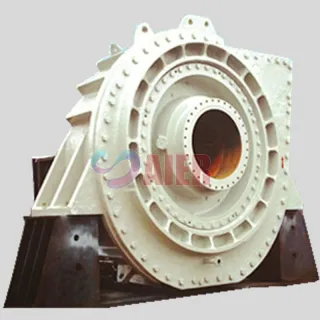
WN dragas sūknis
-
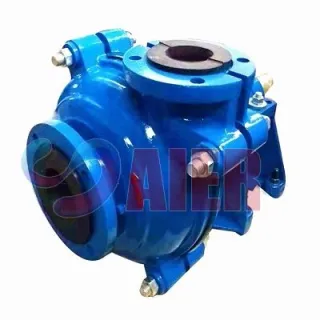
WAJ gumijas vircas sūknis
-
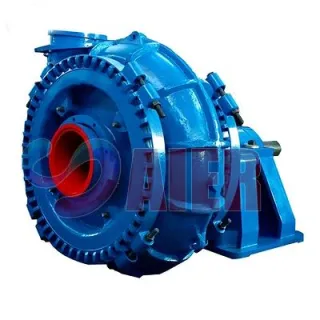
WS, WSG Grants smilšu sūknis
-
WS, WSH Šķīduma sūknis
-
WY sūknis
-
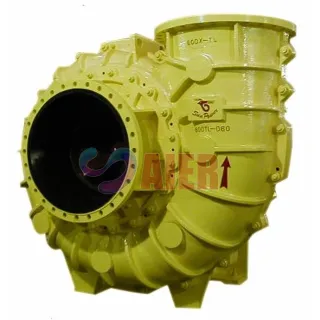
TL, TLR FGD sūknis
-
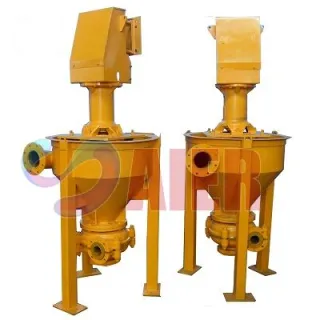
WP vertikālais putu sūknis
-
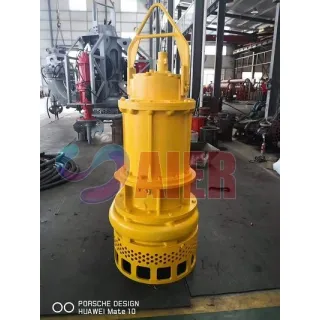
ZJQ iegremdējamie vircas sūkņi
-
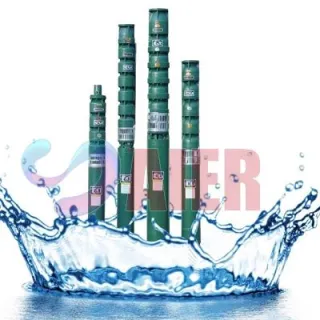
QJ zemūdens sūknis
-
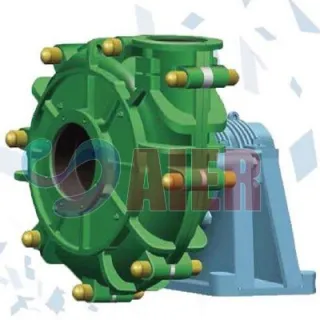
ACT (ZCT) keramikas vircas sūkņi
-
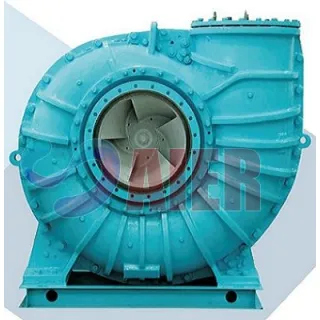
BCT keramikas vircas sūkņi