
POMPE Submersible QJ
Description du produit
Description générale
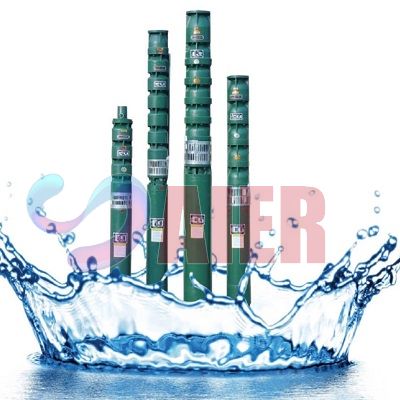
La pompe submersible QJ est principalement utilisée pour transporter l'eau d'un puits profond et la booster et est largement utilisée dans l'irrigation des terres agricoles, le drainage de l'eau dans les zones urbaines et rurales, les mines et les entreprises industrielles et les travaux de conservation de l'eau, y compris le réservoir, la fontaine, le système de refroidissement et le spa, etc. Les principales caractéristiques sont les suivantes : facile à utiliser, installation facile, entretien facile, protection de l'environnement, etc. Avantages, la pompe de plongée électrique qui collecte le moteur et la pompe à eau pourrait fonctionner dans l'eau et elle est pratique à utiliser et à réparer.
Fabricants de pompes à eau submersibles
Nous sommes un fabricant professionnel de pompes submersibles en Chine. En plus des pompes à eau, nous fournissons également diverses pompes à lisier, pompes à gravier, pompes de désulfuration, etc. Selon différentes demandes, nous pourrions fournir des produits avec différents matériaux comme le moulage en acier inoxydable, le soudage sous pression en acier inoxydable, le moulage en bronze, le moulage en fonte ordinaire, Matériau moulé spécial résistant à la corrosion. La pompe doit avoir un diamètre extérieur strict, de sorte que des situations telles que des fuites du joint du moteur et une pollution de l'eau ne se produiront pas.
Caractéristiques
Taille (décharge) : 4" à 16"
Capacité : 2-500m3/h
Hauteur : 10m-500 m
Puissance domestique : 0,75-450 kw
Matériel : Fonte, bronze, acier inoxydable, etc.
AIER® QJ Submersible Pump
Conditions d'utilisation
①Puissance : 380 V/CA triphasé, 50 Hz
②Qualité de l'eau :
A. La température de l'eau est inférieure à 20 ℃ (résistance à haute température 80 ℃)
B. La teneur en solides est inférieure à 0,01 % (dépend de la qualité)
C.PH 6,5-8,5
D. La teneur en sulfure d'hydrogène est inférieure à 1,15 mg/l
E. La teneur en ions oxyde est inférieure à 400 mg/l
③La partie intérieure du moteur submersible doit être remplie d'eau propre et la pompe submersible doit être immergée automatiquement pour fonctionner.
④La profondeur de montage ne doit pas dépasser 20 % de la tête nominale de la pompe à eau et la face du puits doit être lisse et droite.
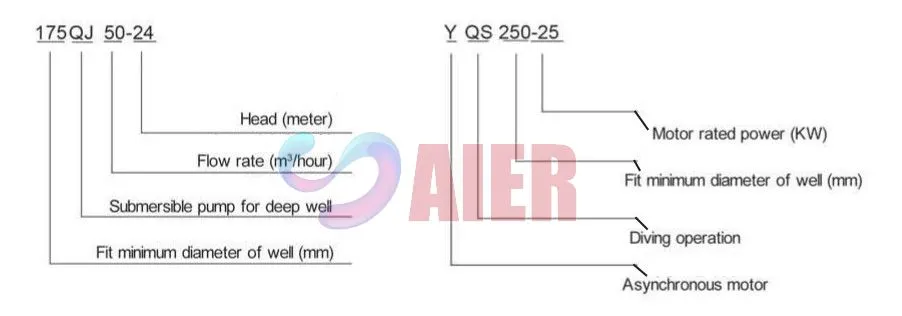
Notation des types
Caractéristiques principales
1. Le moteur est un moteur submersible humide. La chambre du moteur doit être remplie d'eau propre qui est utilisée pour refroidir le moteur et lubrifier les roulements. Le film régulateur de tension sur la base ou le moteur est utilisé pour ajuster la différence de pression et la dilatation de l'eau dans la partie interne du moteur causées par les changements de température du moteur.
2. Afin d'empêcher les grains de sable d'un puits de pénétrer dans la partie intérieure du moteur, une extension supérieure est installée, deux huiles de joints qui sont installées à l'envers et un anneau de sable est installé.
3. Pour empêcher l'arbre de la pompe à eau de sauter, l'arbre de la pompe à eau et l'arbre du moteur sont reliés par un accouplement et un palier de butée doit être installé dans les parties inférieures du moteur.
4. L'eau lubrifie le moteur et le roulement de la pompe à eau.
5. Les fils d'enroulement du moteur submersible sont utilisés pour l'enroulement du stator. Donc ça isole bien
6. La roue centrifuge et le boîtier d'entrée du ventilateur vertical sont utilisés pour la pompe à eau target="_blank"> et la structure est simple.
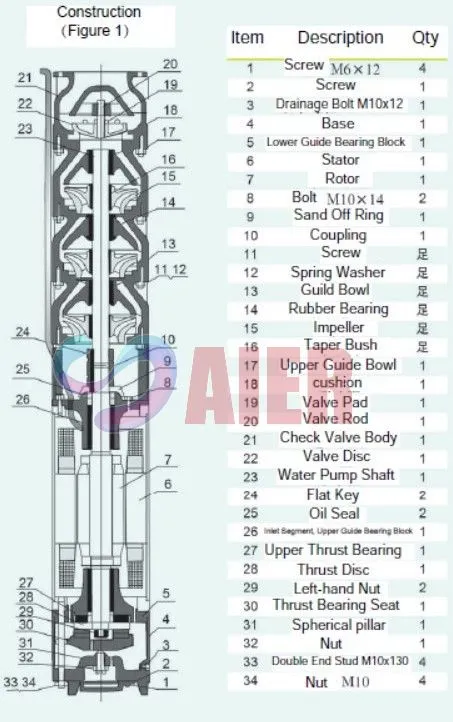
Schéma de construction
La pompe submersible QJ se compose principalement d'un point d'alimentation, d'un arbre de pompe à eau, d'une turbine, d'un boîtier d'entrée de ventilateur, d'un roulement en caoutchouc, d'un clapet anti-retour (option), etc. Le moteur submersible se compose d'une base, d'un film de régulation de tension, d'un palier de butée, d'un disque de butée, d'un bloc de roulement de guidage inférieur. , stator, enroulement de stator, rotor, guide supérieur, bloc de roulement, bague de ponçage, câble de sortie, etc.
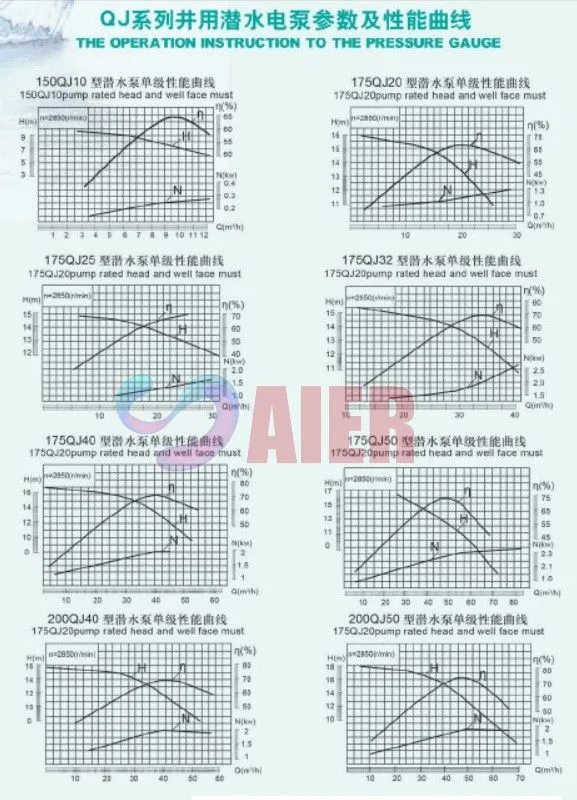
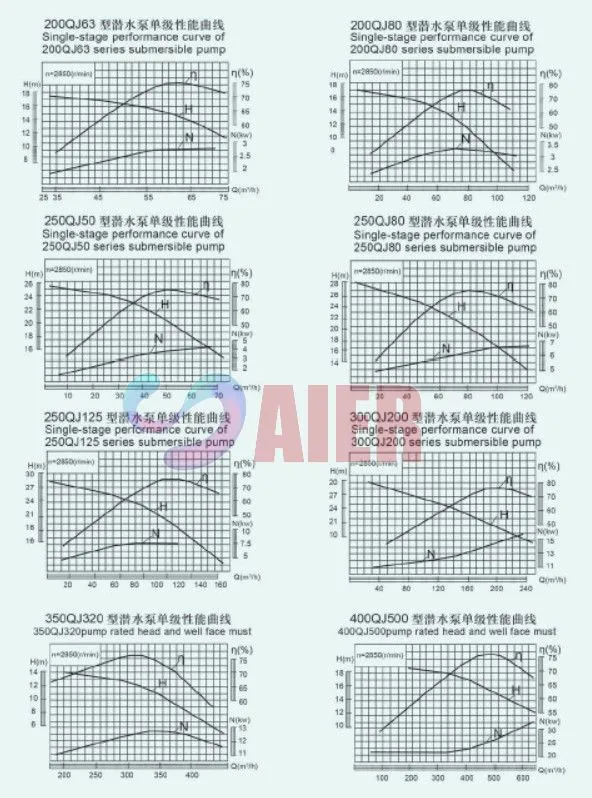
Courbe de performance
Advantages of Using Submersible Water Pumps for Continuous Operation
A submersible water pump is a highly efficient and durable pumping solution designed to work entirely underwater, making it ideal for applications requiring continuous operation. Unlike surface-mounted pumps that rely on suction, a submersible pump pushes water upward through direct contact with the liquid, resulting in higher efficiency, less energy loss, and better performance in harsh environments.
One of the most significant advantages of submersible water pumps is their energy efficiency. Because they operate directly in the fluid, there is no air leakage or suction head loss, which means the pump converts more motor energy into hydraulic power. This makes submersible pumps extremely effective in deep wells, reservoirs, and dewatering systems where long-term operation is essential. Leading submersible water pump manufacturers often equip their pumps with advanced motors featuring high-efficiency windings and low energy consumption for round-the-clock operation.
Another major benefit is the quiet and vibration-free operation. Since the entire pump is submerged underwater, the surrounding fluid dampens sound and vibration. This makes submersible pumps suitable for residential, municipal, and industrial applications where noise control is important—such as building basements, urban drainage systems, and cooling water circulation.
In addition, submersible water pumps are known for their excellent anti-cavitation properties. Because they operate below the water surface, the risk of air bubbles forming at the impeller is greatly reduced. This prevents vapor lock, improves hydraulic stability, and minimizes wear on internal components. The constant immersion of the pump also ensures natural cooling for the motor, extending its service life even during extended operation.
Finally, submersible pumps are easy to install and maintain. Most modern models are designed with modular components, corrosion-resistant casings, and advanced sealing systems. This ensures long-lasting reliability in environments such as wastewater treatment, agriculture, mining, and chemical processing. When you choose a product from a reputable submersible water pump manufacturer, you can expect superior performance, reduced maintenance costs, and reliable operation—day after day.
Maintenance and Troubleshooting Tips for Submersible Water Pumps
Proper maintenance of a submersible water pump is essential for ensuring consistent performance, preventing failures, and maximizing operational lifespan. Since these pumps work entirely underwater, they must endure high pressure, varying temperatures, and possible contact with sediments or chemicals. Following a proactive maintenance plan can significantly extend the efficiency and reliability of your system.
The first step is routine inspection. Regularly check the power cable for cracks, fraying, or water ingress, as damaged insulation can cause short circuits. Next, examine the pump’s exterior for corrosion or debris buildup. Sediment accumulation can restrict water flow and reduce pump efficiency. Cleaning the suction strainer and impeller housing every few months helps maintain optimal performance.
A common issue in submersible pumps is reduced discharge flow. This can be caused by impeller wear, clogged intake screens, or partial blockage in the discharge line. If this happens, disconnect the pump, clean the impeller, and inspect for wear or imbalance. Replacing worn impellers or seals promptly prevents more serious mechanical damage.
The mechanical seal is one of the most critical components of a submersible water pump. It prevents water from entering the motor housing. Any leakage or oil contamination in the seal area indicates the need for immediate replacement. Additionally, monitor the bearing temperature and listen for unusual noises—these can signal excessive friction or bearing wear.
Leading submersible water pump manufacturers recommend checking motor insulation resistance periodically to prevent electrical faults. For pumps used in wastewater or industrial environments, schedule quarterly performance tests to track flow, head, and power consumption. If overheating occurs, it could be due to low voltage or excessive solids in the fluid; cleaning the pump and verifying electrical connections typically resolves these problems.
By maintaining your submersible water pump properly—keeping it clean, well-lubricated, and regularly inspected—you can reduce downtime, prevent costly repairs, and ensure reliable operation for years, even in continuous-use applications.
Key Features of High Quality Submersible Water Pumps
A high-quality submersible water pump is engineered for durability, efficiency, and versatility, making it suitable for use in various industries including construction, mining, agriculture, and wastewater management. Understanding the key features that define a superior submersible pump can help users select the best equipment for long-term operation.
The most important feature is robust material construction. Reputable submersible water pump manufacturers use stainless steel, cast iron, or high-chrome alloys to ensure resistance to corrosion, abrasion, and chemical attack. These materials protect the pump body and impeller from harsh conditions such as sewage, slurry, or seawater exposure. A well-built submersible pump can operate continuously even in environments with high sediment or chemical content.
Another key aspect is the advanced mechanical sealing system. Double mechanical seals made of silicon carbide or tungsten carbide prevent leakage and protect the electric motor from water intrusion. Combined with oil-filled motor chambers for cooling and lubrication, these systems ensure long-lasting reliability and smooth operation.
Efficiency is also a hallmark of a top-tier submersible water pump. Precision-engineered impellers and high-efficiency motors minimize energy consumption while delivering consistent flow and head performance. Built-in overload protection and thermal sensors help prevent damage from overheating or voltage fluctuations, ensuring safety in continuous-use environments.
In addition, modern submersible pumps feature modular and service-friendly designs. Easy-to-remove components allow for quick maintenance without dismantling the entire system, reducing downtime. Anti-clog impeller designs and self-cleaning flow channels further enhance reliability, especially in wastewater or industrial slurry applications.
Finally, certified submersible water pump manufacturers perform rigorous quality control and performance testing to guarantee every unit meets global efficiency and safety standards. When you choose a high-quality submersible pump, you’re investing in a machine that provides stable output, reduced maintenance costs, and decades of dependable operation across multiple industries.
Catégories de produits
-
Pompe à lisier robuste WA
-
Pompe à lisier à haute tête WG
-
Pompe à lisier légère WL
-
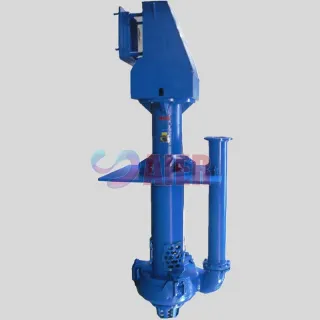
Pompe de puisard WY
-
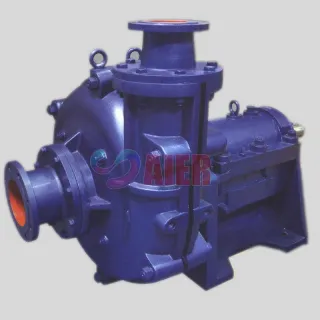
Pompe à lisier haute efficacité WZ
-
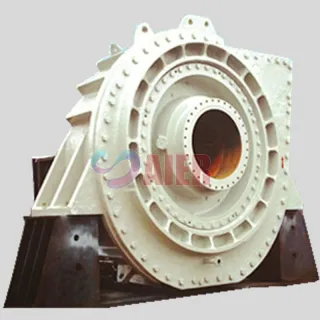
Pompe de dragage WN
-
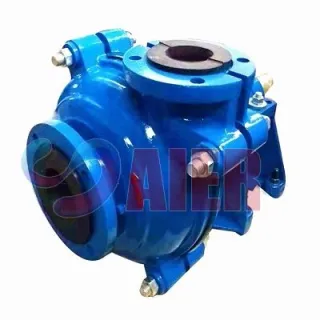
Pompe à lisier en caoutchouc WAJ
-
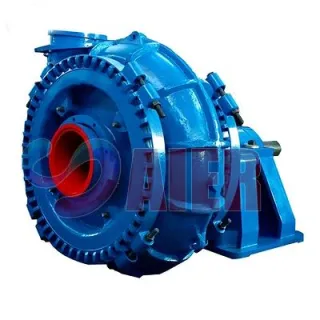
Pompe à sable de gravier WS, WSG
-
Pompe à solution WS, WSH
-
Pompe de puisard WY
-
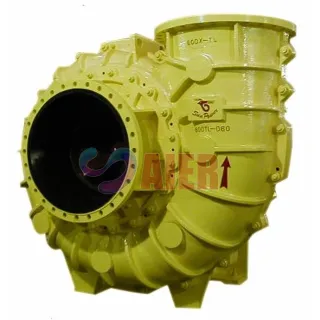
Pompe FGD TL, TLR
-
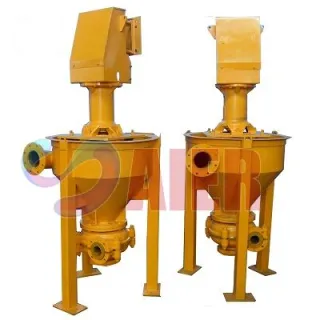
Pompe à mousse verticale WP
-
Pompes à lisier submersibles ZJQ
-
POMPE Submersible QJ
-
Pompes à lisier en céramique ACT (ZCT)
-
Pompes à lisier en céramique BCT