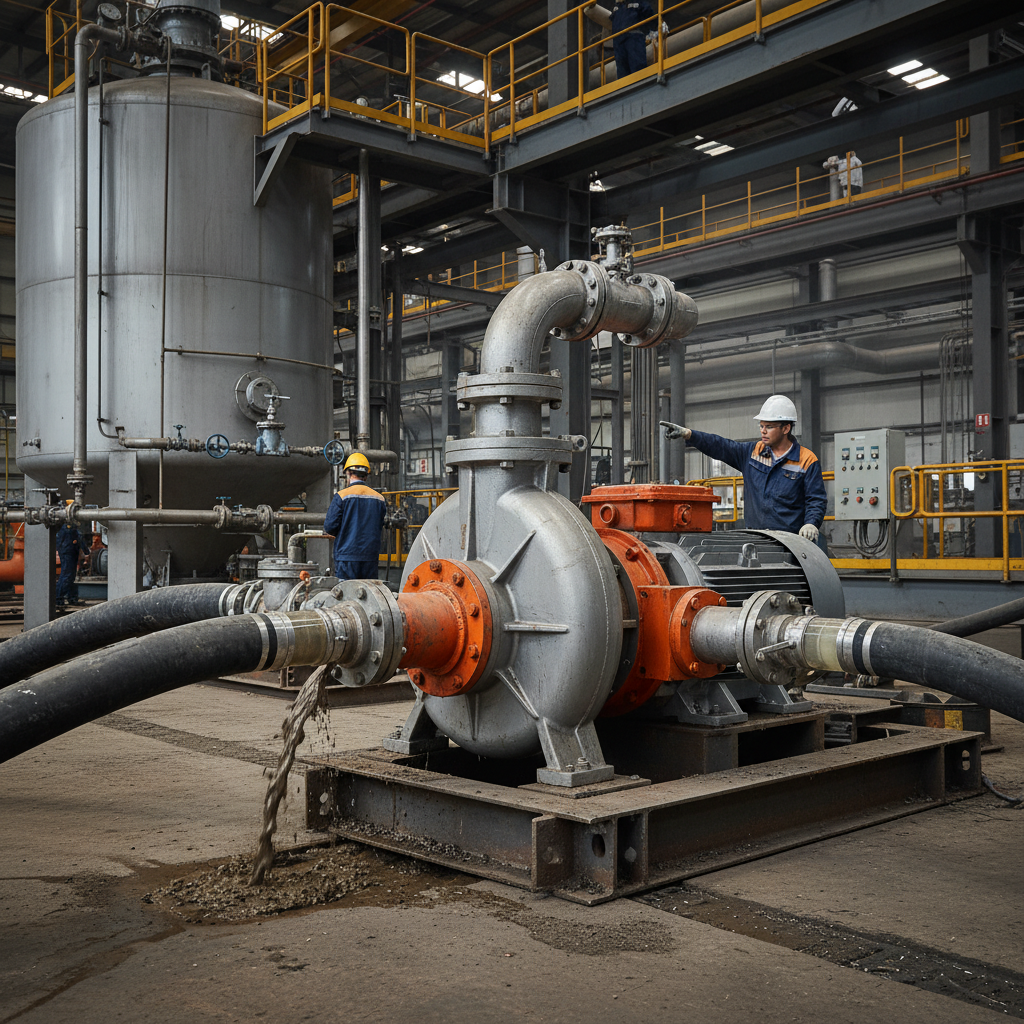
Integrating a pump directly onto an excavator transforms a standard earth-moving machine into a specialized dredging unit, capable of removing sediment and slurry from water bodies with high precision. This hybrid approach minimizes the need for separate pump installations and floating pipelines in shallow or constrained environments.
The technical challenge lies in balancing the hydraulic power of the excavator with the flow requirements of the pump to ensure efficient material transport without overloading the machine. For operators, the focus has shifted from simply moving soil to optimizing the solids-to-liquid ratio during the extraction process.
To achieve sustainable performance in these aggressive environments, selecting a china excavator dredge pump requires an understanding of material science, specifically how wear-resistant components handle abrasive slurries.


Unlike stationary dredging stations, an excavator-mounted system relies on the machine's hydraulic circuit to drive the pump. This allows for extreme mobility, enabling the operator to position the suction intake exactly where the sediment accumulation is highest, reducing the "dead space" often found in larger dredging projects.
The process involves a combined action where the excavator bucket or a specialized suction head loosens the material, and the pump creates the necessary vacuum to lift the slurry through a discharge pipe. This synchronization is critical to prevent cavitation and ensure a steady flow of material.
The effectiveness of a dredge pump is determined by its wet end components. These include the impeller, throatbush, and cover plate liners, all of which are subjected to constant abrasion from sand, gravel, and other suspended solids. In a high-velocity slurry stream, even small particles can act as sandpaper, rapidly eroding standard cast iron components.
To combat this, specialized metallurgy and polymers are employed. For instance, the use of high-chrome alloys or specific rubber compounds is necessary depending on the particle size and the chemical composition of the liquid. If the slurry contains sharp edges, hard metals are preferred; however, for fine, corrosive slurries, rubber is the superior choice.
Aier Machinery Hebei Co., Ltd., established in 2005, focuses on these precision-engineered components. By specializing in slurry and dredge pumps, they provide the necessary OEM castings and spare parts that ensure the pump's internal geometry remains intact over long operational cycles, maintaining the required head and flow rate.
Material selection is not a one-size-fits-all decision. The choice between rubber-lined and metal-lined pumps depends entirely on the nature of the abrasive media. Rubber is highly effective at absorbing the impact of small, rounded particles, whereas metal is required for larger, jagged rocks.
Natural Rubber R55 is currently the industry standard for aggressive slurry applications, particularly where the slurry contains small particle sizes without sharp edges, providing a balance of corrosion resistance and elasticity.
When utilizing Natural Rubber wet end parts—including the impeller and frame plate liner—operators often see a significant increase in the mean time between maintenance (MTBM). This is because the rubber allows the particles to "bounce" off the surface rather than cutting into the material, which is essential for the longevity of a china excavator dredge pump.
Maximizing the output of an excavator-mounted pump requires a precise match between the pump's NPSH (Net Positive Suction Head) and the available head provided by the excavator's location. If the pump is placed too high above the water level, cavitation occurs, leading to rapid impeller pitting and a drop in discharge volume.
Efficiency is also tied to the concentration of solids. A slurry that is too thick will increase friction losses in the pipeline, while a slurry that is too thin wastes energy by pumping excess water. Finding the "sweet spot" of slurry density is the key to reducing fuel consumption and increasing the volume of material removed per hour.
In a typical industrial setting, such as the maintenance of urban drainage canals or the desilting of small harbor basins, the flexibility of an excavator-mounted pump is unmatched. These scenarios often involve varying depths and the presence of debris that would clog a larger, stationary suction dredge. The operator can use the excavator's arm to clear obstacles before initiating the suction process.
However, operational considerations must include the weight of the pump and the piping system. Adding a heavy china excavator dredge pump and associated accessories to the chassis can affect the machine's center of gravity. Proper counterweighting and secure mounting are essential to prevent instability during the lifting and swinging motions of the excavator.
The industry is moving toward modularity, where pump systems can be quickly swapped based on the project requirements. Instead of a permanent installation, many companies are adopting "plug-and-play" hydraulic interfaces that allow an excavator to switch between a standard bucket and a dredge pump system in a matter of hours.
This shift is driven by the need for higher equipment utilization rates. A machine that can function as both a primary excavator and a precision dredge pump is far more valuable to a contractor than two specialized machines. This evolution requires pumps that are compact yet powerful enough to handle high-density solids.
Future challenges include the integration of smart sensors to monitor real-time wear on the impeller and liners. By analyzing flow fluctuations, operators may soon be able to predict exactly when a rubber liner needs replacement, moving from scheduled maintenance to predictive maintenance.
Selecting the right pump for an excavator involves a series of trade-offs between flow rate, pressure (head), and durability. A pump designed for high volume may struggle with thick, viscous mud, whereas a high-pressure pump might have a smaller discharge diameter, limiting the total amount of material moved per hour.
Buyers must evaluate the specific slurry characteristics. If the environment is highly corrosive (e.g., saltwater mixed with chemical runoff), a Rubber Slurry Pump or a specialized Solution Pump is required. For mining-adjacent dredging where heavy gravel is present, a Gravel Sand Pump with high-chrome alloys is the only viable option.
The following framework provides a qualitative comparison of how different pump types perform under various operational conditions, helping operators align their equipment choice with the actual site needs.
| Material Type | Particle Size | Corrosion Level | Suitability Index |
|---|---|---|---|
| Natural Rubber | Fine/Small | High | Excellent |
| High Chrome | Coarse/Large | Low | Excellent |
| Ceramic Lining | Fine/Abrasive | Medium | Very High |
| Standard Cast Iron | Clean Water | Very Low | Low (for slurry) |
| Polyurethane | Mixed | Medium | High |
| Hybrid Metal/Rubber | Mixed | Medium | High |
In this context, a dredge pump is a heavy-duty centrifugal pump designed to handle solids-laden fluids (slurries). Unlike standard water pumps, it features wear-resistant liners and impellers capable of transporting sand, silt, and gravel from the bottom of a water body to a discharge point, powered by the excavator's hydraulic system.
Natural rubber, such as the R55 standard, is ideal for slurries with small, rounded particles and high corrosivity. It absorbs the impact of the slurry, reducing wear. High-chrome alloys are necessary when the slurry contains large, sharp, or jagged particles that would tear or cut through rubber liners.
A higher concentration of solids increases the abrasive force on the impeller and throatbush. If the ratio is too high, the fluid becomes too viscous, increasing friction and heat, which accelerates wear. Maintaining an optimal ratio ensures the pump operates within its design parameters, extending the life of the wet end parts.
No, standard water pumps are not designed for abrasive materials. The solids in a slurry would quickly erode the impeller and housing of a standard pump, leading to a total loss of prime and catastrophic mechanical failure within a very short operational window.
The primary ongoing cost is the replacement of sacrificial wear parts, specifically the impeller, liners, and throatbushes. Using high-quality OEM spare parts from a specialized manufacturer can reduce the frequency of these replacements and prevent unplanned downtime during critical project phases.
The excavator's hydraulic pump sends high-pressure oil to a hydraulic motor mounted on the dredge pump. This motor then converts the hydraulic energy into mechanical rotation to drive the pump's impeller. The flow and pressure are usually regulated via a control valve in the excavator's cabin.
The integration of a china excavator dredge pump represents a strategic shift toward more mobile and flexible sediment management. By focusing on the synergy between hydraulic power and material science—specifically the use of Natural Rubber R55 for abrasive environments—operators can significantly increase the efficiency of their dredging operations.
Ultimately, the longevity of the system depends on a rigorous selection process that matches the pump's material composition to the specific characteristics of the slurry. Investing in precision-engineered wet end parts ensures that the equipment remains productive, reducing long-term operational costs and maximizing the utility of the excavator platform.